
ב"ה
A Talmudic sage was once approached by a good spirit which guarded the local river. It told the sage that an unholy spirit intended to wrest control of the river, and make trouble for the Jews who came to use it. The good spirit instructed the sage: “Gather all the local Jews. When the evil spirit approaches, I will alert you. All the assembled should then stand in its path and shout: ‘Didan Notzach – Victory is ours!’” When the Jews did this a drop of blood appeared on the face of the water, illustrating their victory over the evil spirit.
What a fast day is really about.
The fast of the Tenth of Tevet commemorates the Babylonian siege of Jerusalem (588 BCE), which culminated in the destruction of the first Temple. It is always observed in the week before or after the Torah reading of Vayigash, which relates the story of the dramatic encounter between Yehuda and Joseph. This class explores the inner connection between the two, and offers essential, spiritual guidance for achieving personal and collective redemption. (Likutei Sichos, volume 15)
Inside the story of Tevet 5: the victory of the sacred books
Jewish Educational Media pulls back the curtain on the fascinating saga of the violation of Lubavitch’s sacred manuscripts and books—and their ultimate triumph. From the Rebbe’s earliest public references to the theft of Chabad’s treasured library, it was clear that this was a spiritual struggle over the movement’s very soul—as embodied in its holy writings—and even over the very definition of a rebbe. (Excerpt from the complete film)
The Story of Joseph, Lesson 3
Alone, betrayed, and enslaved, did Yosef become angry and bitter? Why does the Torah keep talking about Yosef’s good looks? How can we use Yosef’s three-pronged strategy thousands of years later? What is the real power of a role model? And how did Yosef fare in jail? We’ll answer all these questions and more in class three.
On the 22nd of Shevat in 1988, the Rebbe's wife, Rebbetzin Chaya Mushka Schneerson, passed away. The Rebbetzin was extremely modest, so not much is known about her life and little footage exists to allow for a comprehensive biography.
This presentation, comprised of the Rebbe's own words following her passing, and first-hand accounts from people who merited to have met her, gives us a peek into the modest loyalty and sacrifice that the Rebbetzin showed. She stood unwavering at her husband's side, and by extension, dedicated her life to the Rebbe's thousands of followers around the world.
Smashing Idols
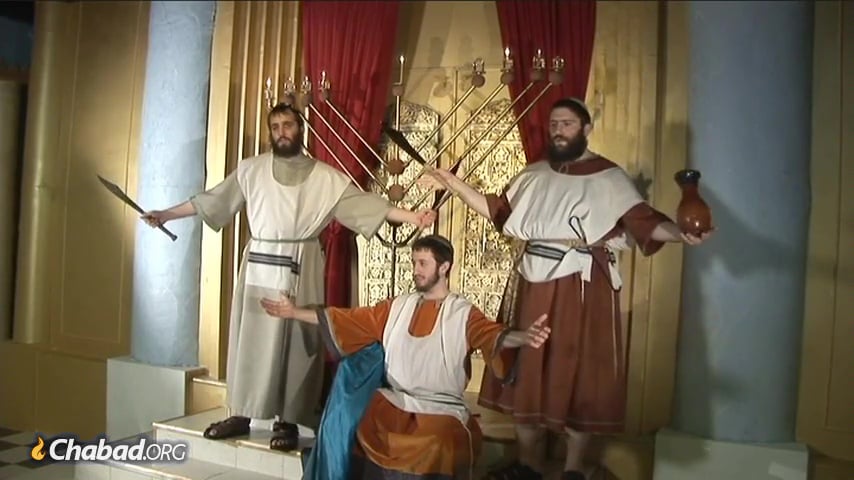
The famous story from the Midrash about how Abraham destroyed the idols in his father's shop. An excerpt from the full DVD “Young Abraham”.
What a fast day is really about.
The fast of the Tenth of Tevet commemorates the Babylonian siege of Jerusalem (588 BCE), which culminated in the destruction of the first Temple. It is always observed in the week before or after the Torah reading of Vayigash, which relates the story of the dramatic encounter between Yehuda and Joseph. This class explores the inner connection between the two, and offers essential, spiritual guidance for achieving personal and collective redemption. (Likutei Sichos, volume 15)
Why answer the nations of the world’s criticism of Israel
The Torah concludes the book of Genesis with the death of Joseph and the fact that he was interned - actually placed in the Nile - in Egypt. Yet we are enjoined by Torah to conclude a Torah subject on a positive note?! The answer sheds new light on both the end and beginning of the first book of the Torah. (Likutei Sichos vol. 30, talk 3)
Parshat Vayechi
Before his passing, Jacob blessed his sons. His youngest son, Benjamin, is praised and blessed: "Benjamin, like a wolf snatches his prey." Strange as this blessing appears on the surface, Rashi's explanations leaves us even more bewildered. This talk will illuminate Rashi's commentary and deliver a powerful message for our times. (Likutei Sichos, vol. 25)
Parsha Vayechi
How Reuven, Shimon, Levi and Yehudah represent four different phases we experience as we go through the order of the morning prayers: 1) Reuven—the first paragraph of Shema, 2) Shimon—the second paragraph of Shema, 3) Levi—the blessings after Shema, and 4) Yehudah—the Amidah prayer. (Based on the discourse "Yehuda Achecha Yoducha 5738.")
Jacob’s last years, spent in Egypt were the very best of his life; filled with true satisfaction and happiness. Whilst it’s not hard to understand that being reunited with Joseph, and seeing his family united and loyal to his hallowed ideals, would be a source of profound joy; there’s something decidedly unsettling about the prime Patriarch being happiest in a place filled with pernicious immorality and spiritual corruption. The Rebbe’s final rumination on this widely discussed subject is revolutionary in its novel approach and leads us into mind-expanding Kabbalistic ideas shedding new light on the age-old question: can people change?!
Letters and Numbers of Torah - Vayechi
"[Jacob] blessed [Ephraim and Menashe] on that day, saying: With you, Israel will bless, saying, 'May G-d make you like Ephraim and like Menashe,'" (Genesis 48:20). Why do Jewish parents continue to this day to bless their children to be like these two grandsons of Jacob? An extra letter vav in the word "saying" holds the hint.
Parsha Vayechi
The Torah portion of Vayechi serves as a "bridge" between the book of B'reishis (Genesis) and the book of Sh'mos (Exodus.) The book of B'reishis relates the miraculous lives of our ancestors. The book of Sh'mos describes our descent into exile. It is the miraculous nature that we have inherited from our ancestors that gives us the power to survive exile. From Likutei Sichos, vol. 30, p.253
Parshah Curiosities: Vayechi
This profound rumination about the last Patriarch’s unique final hours passes into a fascinating exploration into the custom of well-wishing one who sneezes. You’ll be shocked to discover the Torah-true origins to this seemingly superstitious practice, which then begs the question: why would an authentic Jewish practice enjoy near total universal appeal?
Up to his final terrestrial moment the Patriarch Jacob exhibits paranormal stamina, composure and clarity for a person about to pass, and in fact, a glaring scriptural omission indicates he never actually died! How on earth can that make any sense; especially as this entire portion is uniquely revolves around his death with multiple verses explicitly alluding to his demise? Finally, how was his body buried, and did it decompose? Incredible answers that tell us much about Jacob, Joseph and Tzadikim today!
10 Teves, 5748 · December 31, 1987
In the fifth section of the Torah portion of Vayechi, Jacob's blessings to four of his sons are
grouped together: "A troop marches forth from the tribe of Gad... The tribe of Asher will be
a wellspring of olive oil... Naftali is a swift gazelle... Joseph, a robust grape vine by the
spring…" All four blessings demonstrate vitality and initiative.
Nutrition from Shamayim
Can the New Year for Trees be a time for reflecting on the mitzvah of taking care of our health? Learn more about the meaning of Tu B’Shevat, and some of the health and healing properties of the fruits mentioned in Deuteronomy 8:8: “A land of wheat, barley, grapes, figs and pomegranates; a land of oil-yielding olives and [date] honey.”
The origin and meaning of this custom
Our proverbial New Year for Trees is celebrated by most Sephardic Jews (and more recently by many Israelis of Ashkenazi descent as well) with an elaborate fruit-centric sacred ceremony colloquially known as the “Tu B’Shevat Seder.” It’s comprised of carefully choreographed chanting of Scripture and Rabbinic texts, accompanied by an assortment of fruit and wine, which are consumed in an orderly fashion. But why invoke unique Passover verbiage for this fruitful observance? This fascinating presentation sheds light on some of the origins and profound meanings of this enigmatic Torah tradition.
In 1941, the Rebbe travelled to Marseilles, France, to obtain entry visas to the United States for himself and his wife, Rebbetzin Chaya Mushka. While there, the Rebbe maintained his characteristic low profile, but at a gathering in honor of the New Year for Trees, he gave those
present a taste of things to come. (1941)
13 Shevat 5749 · January 19, 1989
“Man is a tree of the field.” The Sages of the Talmud apply this verse to the Jew. Torah is the
core of a Jew’s being, and Torah must effect his actions so that he bears good fruits — good
deeds. But when we say that a Jew must be “fruitful,” first and foremost he must reproduce
his own essence.
11 Nissan, 5744 • April 12, 1984
G‑d created plants and animals with the ability to procreate – to perpetuate themselves and reflect G‑d’s own Infinitude. Man, too, was granted the remarkable ability to reproduce, but was additionally blessed with the ability to harness and expand the infinite powers hidden within the rest of nature.
Chabad of South Broward's 41st Annual Chanukah Festival
The 41th Annual South Florida Chassidic Chanukah festival features a full concert with the highly popular Jewish superstar Mordechai Shapiro, and presents a spectacular light show. The night’s highlight is the lighting of Florida's largest Menorah.
A women’s gathering of learning about Geulah (Redemption)
Join a global webcast for women in learning about Moshiach and the future Redemption. Featured speakers: Mrs. Miriam Swerdlow, Mrs. Perel Krasjansky, Mrs. Leah Kohn, Mrs. Shterna Ginsberg and Rabbi YY Jacobson. (This program is hosted by Neshei Chabad in
Get the Chabad.org Video app