


It wasn’t until several years had passed after my wedding that the bombshell hit me. I was the only one of my friends who was still praying for a child.
I was always something of a go-getter, so when I was the first of my classmates to get married, no one was surprised. “By the time your friends are married, you’ll likely have a baby already,” said my mother lightly.
Not so quick, Mommy dear! Although in the next few years many of my friends transitioned into young wives, I was no closer to changing my status.
It began slowly: One friend complained that she was too tired to join our group for our weekly outings, and then another. I must have been naive because I didn’t catch on to what was happening. By the time I did, there weren’t too many of us left.
Another year or so passed, and it was only me! While “they” were immersed in the joys of motherhood, I was looking for ways to fill my time.
I threw myself into my work … I became a gourmet cook, I went to visit an old lady in a retirement home, I dropped in on my friends and watched them change diapers and feed baby cereal to their offspring. And with all that, I still had extra hours to think, to worry, and at times, even to obsess. When would my turn come?
Time passed. Another Simchat Torah watching my nephews sitting on their fathers’ shoulders as they danced … another Purim admiring the costumes of the neighborhood kids … another Passover listening to the cute (but repetitive) comments of my nephews and nieces at my parents’ Seder. “Ma Nishtana,” the Four Questions a child traditionally asks his father at the Seder, would I ever hear those hallowed words addressed to my own dear husband?
And yet, as taxing as I found those bittersweet occasions, they were not nearly as challenging as the High Holy Days that mark the beginning of another year. The weighty realization that a full 12 months had passed without anything to show for my prayers tore into my soul.
I’d snatch a glance at the young women who would make a brief appearance during the morning prayers to hear the shofar-blowing. Invariably, they were accompanied by swaddled babies and well-dressed children whose sweet little mouths were filled with candies so they wouldn’t make a noise. They left pretty quickly.
As much as I felt hurt, I knew that no one was trying to vex me. It wasn’t that anyone was doing anything wrong; I actually had a nice group of friends who made it their business to invite me over to “schmooze” in the evenings. While they washed their dishes or folded laundry, I was privy to their endless chatter about feeding schedules and teething problems that were soon expanded to include the “terrible twos,” potty-training and their choice of nurseries.
At times, I had to fight back tears, but I wanted their company. My husband had his own pain and didn’t need to be burdened with mine. Without another alternative, I became the reliable sounding board for other people’s joys and frustrations while sharing none of my own. No, I wasn’t going to dampen their happiness, so I always maintained a brave front, a smile on my face and a resolve to keep my anguish hidden.
But I, too, had a breaking point, and it was triggered by an incident so small and seemingly inconsequential that I’m almost embarrassed to repeat it. At this point, I was already approaching 30 and had been trying to have a child for several years. As I ambled to shul that Rosh Hashanah morning, my neighbor, who was a very young mother of three, dealt a crushing blow that demolished my carefully nurtured resolve.
“Rachel, I’m so jealous of you. You’re really lucky to be able to go to shul.” Ouch! I had no words. Better I should make myself scarce before she even realized the foolishness of what she’d said (or maybe she never did).
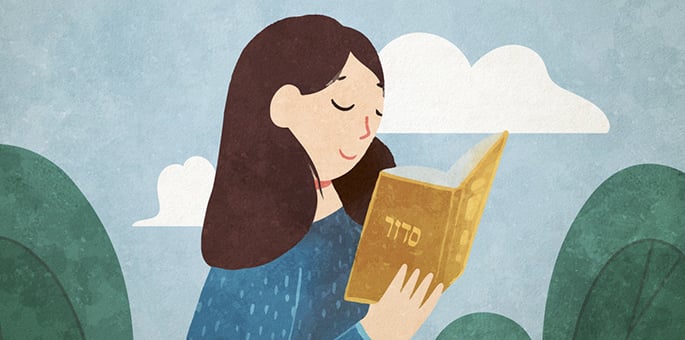
At least, I had my synagogue as a refuge. And yet now, even my familiar seat and well-worn prayerbook could give me no comfort. Eventually, the dam burst, and my whole body heaved with the anguish of so many years of thwarted hopes. Long, hard sobs that came from the core of my being—from an “inner me” that I was not even aware of before.
Tch, tch! The stern looking woman next to my right clucked her disdain at such an open display of raw emotion.
What? She, too? Can’t I even get some empathy from a middle-aged woman who’s probably raised a bunch of children of her own?
G‑d! Only You can help me!
I was sure that I was screaming aloud, but since no one had turned around to stare, I noted with relief that the screaming must have come from my soul and hadn’t been heard.
Or maybe, it had. Was it my imagination or did my disapproving neighbor take a quick glance into my eyes and guide them to my prayerbook? I dutifully picked it up and listened to the cantor so I could find the place. Could it be that my outburst had only lasted a few minutes? The cantor was now reading the Haftarah of Rosh Hashanah.
It seemed as if everything was standing still.
In a sense it had because as I listened to the story of Hannah, I felt I had all the time in the world to ponder the plight of the childless Hannah who went to the Temple at Shiloh to pray for a son.
In her wretchedness, she prayed to the L-rd, weeping all the while.
And she made this vow: “O L-rd of Hosts, if You will look upon the suffering of Your maidservant and will remember me and not forget Your maidservant, and if You will grant Your maidservant a male child, I will dedicate him to the L-rd for all the days of his life; and no razor shall ever touch his head.”
The eternal words of the prophet Samuel gave me a jolt. Hannah was not asking for a child for her sake; she wanted to bring a child into this world only that he should serve G‑d.
Perhaps, I’d been wrong all along. I’d been asking for a child for me when I should have been asking for a child for You!
For You, G‑d! Not for my vanity, not for my comfort, not to feel equal to other women and not to care for me when I am old. I want a child who will give You pleasure by having a relationship with You and spreading Your Truth.
I felt cleansed and uplifted. I had used Hannah’s prayer, and I dared to hope that I would now merit to receive the same blessings as she.
And indeed, I did!
That was my last Rosh Hashanah in synagogue for several years, as I was blessed with the birth of my first child the following month of Elul, right before the New Year. As it turned out, we didn’t call our baby Samuel, as Hannah called her son. Instead, I called her Chana/Hannah, the name of my late mother-in-law.




Start a Discussion