


Dancing Torah?
Dear Friend,
Simchat Torah is coming! It’s the crowning moment of a holiday season that has spanned the full gamut of human emotion. The theme of this holiday is unbridled joy—sheer happiness.
But whose happiness is it? Simchat Torah means “the happiness of the Torah.” How do you get a scroll to celebrate?
Here’s a thought: The Zohar teaches us that Torah, G‑d and Israel are all one. Thus, when we rejoice in our connection to G‑d, He rejoices with us. And when we and G‑d celebrate together, we can be sure that the Torah dances right along as well.
So what are we waiting for? Let’s celebrate!
L’chaim!
The Chabad.org Editorial Team
Discovering Eden
Dear Friend,
Remember the first time you ever heard of the Garden of Eden in this week’s Torah portion? I’m pained to confess I more readily remember the first time I heard about Darwin.
In terms of formal education, I’ve spend a lot more time in secular classrooms than in Torah classrooms. And I remember quite clearly learning the Theory of Evolution as a child. It was fascinating.
But as an adult with quite a bit of secular studies under my belt, and a little Torah learning, I know that it was also devastating. When you teach a child that she or he is a cousin of the chimpanzee, and ultimately descends from an amoeba or a virus, this causes a devastation in the child’s soul.
Now I’m not going to explain in this brief note why I think Darwin’s theory can be put in its place by means of critical thinking. Here I just want to express how grateful I am to the Torah for teaching us that when our oldest ancestors first opened their eyes, it was not a jungle that they saw around them. It was a divine garden. A garden named Delight. Eden.
Where is Eden? It’s the place where we cultivate the soil of our Delight, “tilling it and tending it” (Genesis 2:15) with the sweatless brow of our mitzvot, making it a lovely little paradise, safely enclosed from the surrounding jungle and its restless monkey calls, in which to spend precious hours with Holy One Who put us there.
Michael Chighel,
on behalf of the Chabad.org
Editorial Team
The Alter Rebbe’s Code of Jewish Law: Online in English for the First Time
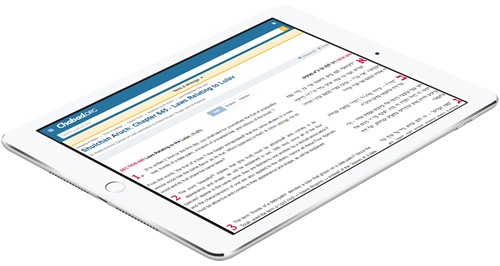
Perhaps no Jewish holiday is more joyous than Sukkot, when Jews of all backgrounds spend time in sukkahs (mobile or stationary), and shake the lulav and etrog as a sign of Jewish unity. These holidays are often accompanied by various laws and rituals that need to be mastered to correctly perform the mitzvah.
Considered a magnum opus on Jewish law, the Shulchan Aruch of the Alter Rebbe, Rabbi Shneur Zalman of Liadi, is renowned for its clear codification and analyses on the day-to-day laws of Jewish life. It’s often considered essential for understanding the many mitzvahs performed during holidays throughout the year.
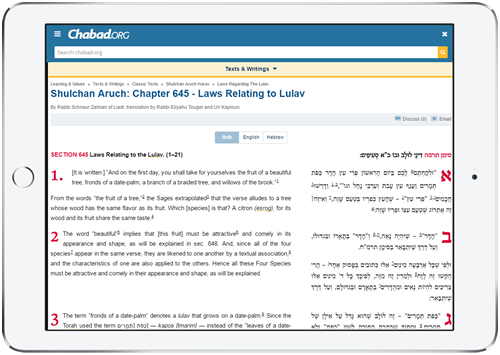
To make these texts more accessible, Sichos in English (SIE) undertook the monumental task of translating this text for the first time into English, employing a team of scholars, researchers and designers. They partnered with Kehot Publication Society, who are the publishers of the original Hebrew version. To date, they have published six volumes of the Alter Rebbe’s Shulchan Aruch. It has now been published online in a beautiful new side-by-side English translation.
SIE’s groundbreaking translation of this seminal work in English has become a staple in Jewish homes around the world. In a unique partnership with Chabad.org, this extraordinary resource is now also being made available online.
This first online installment features all the laws of the High Holidays: Rosh Hashanah, Yom Kippur, Sukkot, and those regarding the Lulav and Etrog. Diagrams illustrate and elucidate some of the more complex halachic topics, making this edition particularly useful for understanding how to build a kosher sukkah and the like. Additional installments will cover the entire first volume of the Shulchan Aruch, including the laws of waking in the morning and daily prayers.
A highly specialized engine was developed by Chabad.org engineers to seemlessly digitize and elegantly display the Shulchan Aruch, preserving the intuitive layout of its printed counterpart. Features include the ability to display all the sources, footnotes, and the side-by-side Hebrew and English translations. An all-Hebrew version was also developed for Chabad.org’s Hebrew-language site.
The partnership between Chabad.org and SIE goes back almost two decades. Currently, more than 100 complete books have been published online by SIE on the Chabad.org platform.
According to Rabbi Yonah Avtzon, executive director of SIE publications, “having a work of this magnitude available in English for the first time online is yet another step in our commitment to making core Jewish and Chassidic texts accessible to Jews around the world.”
What Makes a Fruit Beautiful?
Dear Friend,
The story is told about a Chassidic Rebbe who would go to great lengths and expenses to obtain the most beautiful etrog available in order to perform the mitzvah in the best possible manner every Sukkot.
Each day of the holiday, after he himself would perform the mitzvah of taking the Four Kinds, it was his custom to allow others to use his lulav and etrog as well. Many would avail themselves of this privilege.
One day, after the rabbi’s etrog was returned to him all battered and stained by hundreds of hands, he was asked: “Why do you allow so many people to use your etrog? Look at what’s happened to it! It has lost its hiddur, its beauty!”
“Why,” the Rabbi replied, “this is the most beautiful etrog in the world! What greater beauty can there be for an etrog than the fact that hundreds of Jews have performed a mitzvah with it?”
The lesson is clear. If you have your own set of Four Kinds, beautify it by helping another Jew perform the mitzvah. And if you don’t yet have your own set, contact your local Chabad rabbi to either obtain a set or help beautify his!
Rabbi Yehuda Shurpin
on behalf of the Chabad.org Editorial Team
Yom Kippur: Edit Away!
Dear Friend,
An editor is the writer’s natural enemy. And a great editor is the writer’s greatest enemy. As any writer can attest, it is painful to watch someone deftly decide that a carefully chosen word or delicately constructed paragraph is unnecessary. Painful, but healthy. Because the skilled editor trims away the static and allows the message to shine through.
People tend to think of the teshuvah we do on Yom Kippur (which begins on Tuesday evening) as some sort of punishing exercise. Perhaps it would be better to see it as a form of self-editing. We take a look at what we have done and where we are going, and then cut out the behaviors and patterns that are keeping us down. Freed from the baggage of our old habits, we are healthy, pure and pristine.
Let’s get editing!
The Chabad.org Editorial Staff
- Mazel Tov! The 12 Pesukim Turn 50
Wednesday, April 22, 2026 - Humanity Just Flew Around the Moon, Here’s the Rebbe’s Lesson
Tuesday, April 07, 2026 - Four Epic Moments From the CTeen Shabbaton
Wednesday, February 25, 2026 - New Short Film: “The Joshniks”
Sunday, February 15, 2026 - Watch: 6 Epic Stories Told at the Conference
Tuesday, February 10, 2026 - Complete Chumash and Navi Classes Now Available
Thursday, January 29, 2026 - We’re Pleased to Present: Mishnah for Kids!
Wednesday, December 24, 2025 - Sydney Massacre: What Now?
Wednesday, December 17, 2025 - Mourning Mrs. Faiga Kaminker
Monday, December 08, 2025 - FAQ: What You Need to Know About the 'Prays Worthy' Summit
Tuesday, November 18, 2025 - Subscribe

- Chabad.org (61)