Question:
What is the deeper significance of the Tallit?
Answer:
The main idea of Jewish prayer is to connect to G‑d. But how can a finite, limited human being connect to an infinite, unlimited G‑d? Really, it should be impossible. But G‑d wants a relationship with us, so He “limited” Himself.
He did this by expressing Himself in creation. The world we live in is actually an expression of G‑d. Just like a piece of music is an expression of the musician who wrote it, and a painting is an expression of the painter, so too this world and everything in it is G‑d’s work of art. We can’t see G‑d, but we can see His creation. So, just as by looking at a painting or hearing a song we can get a feeling of who the artist is, by observing the beauty of this world, its complexity and its rhythms, we can begin to appreciate G‑d.
But (and this is a big but), even though creation expresses G‑d, it could never express His real self. As beautiful as the world is, it is only an insignificant fraction of G‑d’s true wisdom. And this is where G‑d is very different from an artist. To truly express himself, the artist has to put all his concentration, effort and creativity into his work. But for G‑d to express Himself, it’s exactly the opposite—He limited Himself, lowered Himself to make a physical world. It would be like the brilliant musician having to write a corny jingle about yogurt for a radio ad. Does that express his genius? No! It expresses his patience! Similarly, G‑d didn’t need to invest “effort” in creating such an amazing world. The only effort was in His limiting Himself to create such a finite existence.
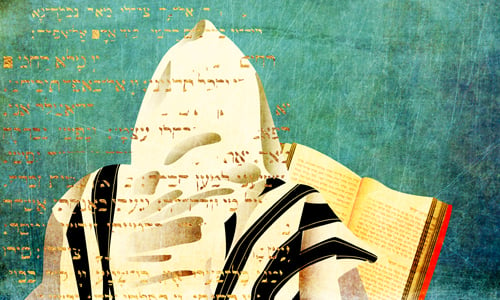
The tallit has two parts: the garment itself, and the tzitzit (fringes). The garment surrounds our body, and the fringes hang off it. They represent the two aspects of G‑d’s being. His true self is totally beyond our capacity to grasp, represented by the garment that envelops us. It is only a tiny fraction of His being, the little fringes dangling off the corners, that we can experience.
No matter how holy we feel, G‑d is infinitely holier. He is the tallit that surrounds us. But no matter how unholy we feel, G‑d comes down to us and asks us to talk to Him. He is the tzitzit reaching down for us to grab on to and kiss.
We need to have this in mind when we pray, so we wear a tallit.