


You've probably heard of some famous Jewish rituals associated with bread—like separating challah from dough, washing hands and saying a special blessing before eating, and reciting Grace After Meals. But there are so many other fascinating Jewish bread-based customs and traditions! Here are 12 of our favorite ones.
1. Unique Shabbat Loaves
In Jewish tradition, bread holds a place of honor as the foundation of any meal. That's why on Shabbat and holidays, after reciting Kiddush over wine, the first food we eat is bread.
Many people picture braided, soft challah loaves for Shabbat. But Jewish communities around the world have their own beautiful variations! For example, Yemenite Jews traditionally serve lachuch, a delicious flat, fried bread, while Persian Jewish tables feature barbari, a flat, glazed bread that's equally special.
2. Treating It With Respect
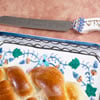
Bread may not be human, but as the staff of life, the Torah teaches us to treat it with respect. That's why tradition says we shouldn't throw bread or do anything that might spoil it—like passing liquid over it or placing raw meat on top.1 We also avoid throwing away edible pieces of bread that are olive-sized or larger.2
3. Two or Twelve Loaves for the Shabbat Meal
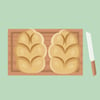
When the Jewish people wandered through the desert, G‑d fed them special bread from Heaven called Manna. On Shabbat, no Manna fell; instead, everyone received a double portion on Friday. To commemorate this miracle, we start the Shabbat meal with two challah loaves, called lechem mishneh.
Read: Lechem Mishneh—The Two Shabbat Loaves
But there's a beautiful Kabbalistic tradition to serve not just two but 12 loaves on the Shabbat table, honoring the 12 loaves of showbread that were displayed in the Temple Sanctuary.3 Some women bake 6-stranded challah or challahs that separate into 6 small rolls, so the two challahs can represent 12. Another custom assigns different numbers to each meal: 12 for Friday night, 8 for Shabbat day, 4 for Shabbat evening, and 2 for the post-Shabbat meal—totaling 26, the numeric value of G‑d's name.4
Read: The Showbread
4. Disposing of Crumbs With Care
It's customary not to toss breadcrumbs on the ground where people might step on them. According to tradition, this could invite poverty into your home.5
5. Sephardic Jews: Dipping Into Sugar on Rosh Hashanah
Throughout the year, it’s customary to dip challah into salt before eating. On Rosh Hashanah, honey takes salt's place, symbolizing our hopes for a sweet new year. But here's something you might not know: some Sephardic Jews dip their Rosh Hashanah challah (and apples) into sugar instead.
6. Shabbat After Passover: “Schlissel” Challah
During Passover, matzah replaces bread, so challah takes an 8-day vacation. When it makes its comeback on the first Shabbat after the holiday, it might look a little different!
Some Ashkenazi communities bake “schlissel” (key) challah for this Shabbat—either shaped like a key or baked with a (foil-wrapped) key inside. Why? One explanation: When the Jewish people entered the Promised Land, the Manna stopped falling right after Passover, and they began working the land to make a living. The key-shaped challahs represent G‑d unlocking the gates of our own livelihood.6
7. Other Challah Shapes
Various communities prepare uniquely shaped challahs for special occasions throughout the year:
Bird-shaped challah: Served at the last meal before Yom Kippur. This recalls G‑d's protection, as Isaiah prophesied, “Like flying birds, so will the G‑d of Hosts protect Jerusalem—protecting and rescuing, passing over and delivering.”7
Hand-shaped challah: Made for Hoshanah Rabbah, the seventh day of Sukkot—a day focused on prayer and supplication. The hand symbolizes reaching out to G‑d for Divine assistance.
Ladder-shaped challah: Baked for Shavuot, the day of the Giving of the Torah. The Hebrew word for ladder, sulam, has the same numeric value as Sinai. Some challah bakers create ladders with five rungs, representing the Five Books of the Torah.
8. Grasping It With 10 Fingers
Before breaking bread, we ritually wash our hands and recite a special blessing: Hamotzi lechem min ha'aretz – “Blessed are You, L-rd our G‑d, King of the world, Who brings forth bread from the earth." When saying this blessing, some people hold the bread with all 10 fingers. Why? The 10 fingers represent the 10 mitzvot connected to bread and its preparation.8
- The prohibition to plow with a cow and a donkey together
- The prohibition to sow mixed seeds
- Leaving fallen stalks for the poor
- Leaving forgotten sheaves for the poor
- Setting aside a corner of the field for the poor
- Bringing the first kernels to the Temple
- Separating terumah for the Kohen
- Separating a tithe for the Levites
- Separating a second tithe to eat in Jerusalem
- Separating challah
9. Leaving Some Uneaten
There is a custom not to finish the entire loaf of bread at a meal, but to leave some uneaten. This symbolizes blessing and abundance.9
10. Moroccan Jews: “Haman's Eyes” Bread on Purim
For the joyous Purim holiday, Moroccan Jews prepare ojos de Haman, or “Haman's eye” bread. These sweet loaves, traditionally studded with nuts and seeds, are shaped to resemble Haman's face. Hard-boiled eggs serve as his eyes, and during the meal, the eggs are pulled out of the bread—symbolizing tearing out the wicked Haman's eyes!
Jews from Rhodes have their own festive Purim bread called folares, with strands of dough encasing a hard-boiled egg. This represents Haman (the egg) trapped in a cage (the bread).
11. Not Passing It Directly
When serving mourners, bread is handed to them directly. For this reason, it's customary not to hand bread directly to anyone else, to avoid any association with mourning. Instead, place it on the table for others to take for themselves.10
12. Not Giving Blessed Bread to an Animal
The piece of bread you start your meal with has a special status because a blessing was made over it. That's why it's customary not to feed that particular piece to an animal.11

Join the Discussion