


Sons say Kaddish for their fathers and mothers for the first eleven months after their passing and every year on the anniversary of their passing (according to the Jewish calendar).
But let's say there is no son—or maybe there is, but perhaps he's been relocated by his employer to Karachi where it's not easy to find ten Jewish men three times a day. In this case, you have two options:
1. Ask another relative.
If there is no son to say Kaddish, another male—preferably a close relative—should say the Kaddish. (Some are of the opinion that first preference goes to a son-in-law.1) However, that should not be a person who has both parents still alive. If you wish to say Kaddish for someone but both your parents are, thank G_d, still in this world, you should ask your parents' permission.2
2. Ask someone else.
In a case where there is no son or relative who can make it to a minyan to say the Kaddish, someone else should be asked to do it in their stead3. This person will need to be told the Hebrew name of the deceased and the Hebrew name of the deceased's father. It is best if the relatives pay this person a stipend4. Many rabbinical colleges provide this service in return for a donation. You can also access such a service by clicking here.
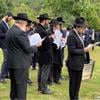




There’s an initiative to say Kaddish for the murder victims in Israel. Thank gd both my parents are still alive and please gd I’ll never need to say Kaddish for them as I have 2 brothers and im a woman. No charitable donation will be given. Is it permissible for me to say Kaddish in an instance like this where there aren’t enough people to say it for the dead? I’m probably not a great candidate on paper.
That is very sensitive of you. I am sure that there are many people who can and will say Kaddish for them. Yet, there is a great myth about Kaddish that this is the sole means to commemorate the passing of a person. Actually, Kaddish is about praising G-d, and makes no mention of death or mourning. Therefore, any Mitzvah that we do in honor of those who have passed, whether it reciting Psalms, studying Torah, donning Tefillin, or lighting Shabbat candles, are all things that help the soul of the departed.