


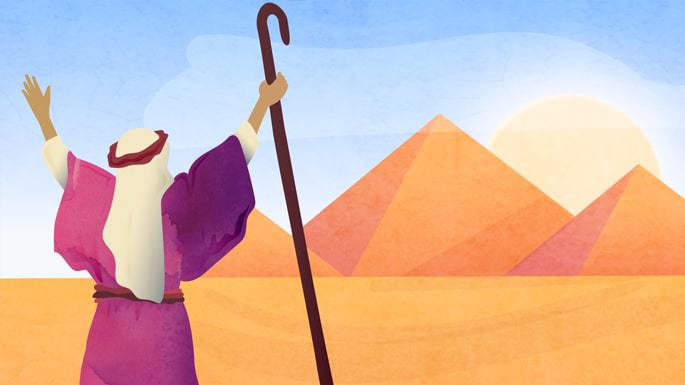
Moses’ staff figures prominently throughout the story of the Exodus from Egypt and our ancestors’ subsequent sojourn in the desert. We first encounter the staff at the incident of the burning bush, where G‑d asks Moses what he has in his hands, and he replies, “A staff.” At the end of the incident, the verse tells us that Moses returned to Eygpt and “took the staff of G‑d in his hand.”1
Yet, other than informing us that Moses used his staff to perform many miracles—including turning it into a snake,2 bringing about some of the plagues, and drawing water from the rock3—Scripture itself doesn’t tell us anything unique about the history of the staff or why it is referred to as “the staff of G‑d.”
Twilight of Creation
The staff’s uniqueness is first mentioned in the Mishnah,4 which lists Moses' staff as one of ten wondrous things created at twilight before the first Shabbat of Creation.
Passed Down the Generations
The Midrash5 relates that this staff was given to Adam in the Garden of Eden. In turn, Adam gave it to Enoch, Enoch to Noah, Noah to Shem, Shem to Abraham, Abraham to Isaac, and Isaac to Jacob. Jacob brought it to Egypt and passed it on to his son Joseph. When Joseph died, the Egyptians pillaged his household goods, and the staff was placed in the palace of Pharaoh.
Eventually, Jethro, who was then one of Phroah’s advisors, saw the rod and the letters upon it (see more on that below), and he desired it. So he stole the rod and brought it to Midian, where he planted it in the middle of the garden of his house. From that point, no one was able to pull it from the ground.
Moses Takes the Rod
When Moses fled Eygpt and came to Jethro’s house, he went into the garden, saw the rod, and read the letters upon it. He pulled the rod out of the ground, which no one had been able to do until then. Jethro observed this and said: “This one will one day redeem Israel from Egypt.” He therefore decided to give his daughter Zipporah to Moses as a wife.6
What Did It Look Like?
In the Midrash we find that the staff was made out of sapphire.7 Another tradition is that it was made out of wood from the Tree of Knowledge.8
Additionally, inscribed on the staff was G‑d’s four-letter name (the Tetragrammaton)9 and דצ”ח עד”ש באח”ב (Detzach Adash B’achav), which turned out to be an acronym for the ten plagues.10
What Happened to It?
The Midrash tells us that the staff was passed down from generation to generation and was in the possession of the Judean kings. Thus, the Midrash relates that the verse concerning King David, "And he took his staff in his hand,”11 is a reference to Moses' special staff.12
Before the Temple was destroyed, this staff was hidden. Some say it was placed together with the implements of the Tabernacle that Moses made as well as the Holy Ark.13
The Midrash relates that Moses' staff will ultimately be given to the Messiah during the messianic era.14 May it be speedily in our days!


