


What We Do
Before we get to work, especially on such a sensitive and cosmic task as the ritualistic handling of food to manipulate spiritual truths, our hands should be clean. Wash them clean of the impurities of a life in a materialistic world.
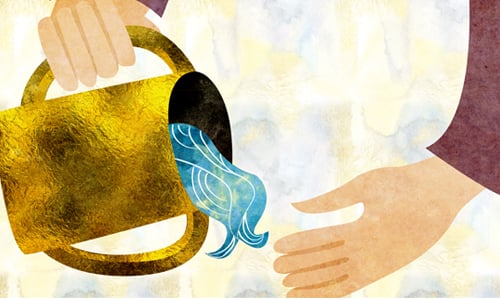
Fill a cup with water.
Many Jewish homes have a large two-handled cup especially designed for this. You could leave the table to go to the kitchen.
What? We just sat down and now we have to get up and leave already? Well, that’s a fairly normal migration pattern for Jews.
On the other hand, you could bring a basin and towel to the table.
Pour the water to cover your right hand. Repeat. Repeat again. Ditto for your left hand.
That’s how the kohanim ("priests") did it when they entered the Holy Temple in Jerusalem.
Dry hands.
Usually, we would recite a blessing at this point. When we wash the second time before eating the matzah, we’ll say it then. But not now.
What It Means
Our hands are the primary tools to interact with our environment. They generally obey our emotions: Love, fear, compassion, the urge to win, to be appreciated, to express ourselves, to dominate. Our emotions, in turn, reflect our mental state.
But, too often, each faculty of our psyche sits in its cell, exiled from one another. The mind sees one way, the heart feels another and our interface with the world ends up one messy tzimmes.
Water represents the healing power of wisdom. Water flows downward, carrying its essential simplicity to each thing. It brings them together as a single living, growing whole. We pour water over our hands as an expression of wisdom pouring downward passing through our heart and from there to our interaction with the world around us.




Shalom. The Urchatz: (washing of the hands). When the steps say to wash your hands symbolically, what they mean is to wash your hands with salt water (called, osmosis). This was good hygiene, regularly practiced in ancient times, and considered to be an act of purification, as salt gets rid of bacteria, and heals wounds (as well as preserving foods). At the Sedar table, a bowl of cooled, boiled, salted water can be placed next to the person reading the Haggadah. I suggest covering the bowl with a cloth to prevent microbes from entering into the salted bowl of water to prevent contaminating it; (which would mean the water would no longer be considered pure). The guests can also have a bowl next to their plates, therefore, keeping everyone seated without causing a disturbance. Please wait to follow the (Haggadah) reader's instructions due to the importance of which hand should be washed first. Personally, I would use two, separate bowls; one for each hand and a cloth to dry your hands.
Thank you. Good lesson!
Early Pesach Sameyah to you.