


1. Jews Have Lived There Since the Dawn of Our Nation
Before G‑d called on him to travel west to the Holy Land, Abraham, the father of our nation, lived in what is now Syria.1 Years later, King David captured much of that territory,2 which attained a status of quasi-sanctity, not quite like the Land of Israel proper, but not like the Diaspora either.3
2. There Are Halabi and Shami Jews

The two greatest centers of Jewish life were in Aleppo and Damascus. Aleppo is referred to in Hebrew as Aram Tzova (pronounced Aram Soba, by Syrian Jews). Its Arabic name is Halab (which was mangled into “Aleppo” in English), and its people are referred to as Halabi.
Damascus is referred to among Syrians as Al-Sham, and the Jews of Damascus and their descendants are referred to as Shami.
3. There Were Many Notable Syrian Rabbis
The classic collection Likdosim Asher Baaretz by Rabbi David Laniado lists hundreds of notable Syrian scholars, each of whom contributed to the advancement of Torah learning.4 Here is a sampling of some of the best-known scholars, some of whom called Syria home and some who just passed through:
Rabbi Saadia Gaon (c. 882-942): Brilliant leader of the Babylonian Torah academy who rendered the entire Torah into flowing Arabic, and whose teachings and traditions remain central to Judaism today. While in Aleppo, he was instrumental in preventing the Jewish world from fragmenting into a situation that would have involved different places using different calendars.
Rabbi Yosef Bar Yehuda (c. 1160–1226): A student of Maimonides, he was an outstanding scholar, physician, and philosopher in Aleppo, where he lived for many years. Maimonides wrote the Guide to the Perplexed to assist him in his efforts to reconcile his philosophical beliefs with belief in G‑d.
The Dayan Family: As their name indicates (dayan is Hebrew for “judge”), successive members of the Dayan family, direct descendants of King David, served as rabbis in Aleppo for centuries.
Rabbi Shemuel Laniado (--1605): Born in Aleppo to Sephardic parents, he studied under Rabbi Yosef Karo in Safed before returning to his hometown where he served as chief rabbi for four decades. He was known as the Baal Hakelim, because the titles of many of his published works began with the word keli.
4. Aleppo Had a Giant Synagogue Complex
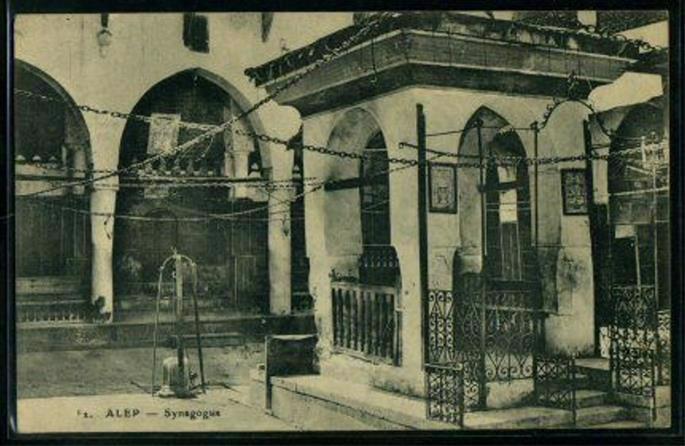
The Great Aleppo Synagogue (known locally as al safra, “the yellow”) was actually a complex with several synagogues, including an outdoor sanctuary that was used during the dry summer months. It had seven holy arks on the southern wall, consistent with the tradition that synagogues face toward Jerusalem (Aleppo is north of Jerusalem).
The synagogue was destroyed during the 1947 violence that broke out after the UN’s declaration of the partition of Palestine. It has since been partially restored but is rarely, if ever, used.
5. The Aleppo Codex Was Their “Crown”

For more than five centuries, the Jews of Aleppo were stewards of a priceless annotated text of the entire Tanach, known as Keter Aram Tzova (“The Crown of Aleppo”) or the Aleppo Codex, thus named because it was bound as a book (“codex”) as opposed to the traditional scroll format.
The book—which was produced by the famous Ben Asher family of Tiberia—came to Damascus along with a descendant of Maimonides, who treasured the Keter and consulted it in his own quest to identify the most proper and accurate Torah text.
Unfortunately, a portion of the Codex went missing when the Great Aleppo Synagogue was destroyed in 1947. The remainder is now housed in the Shrine of the Book in Jerusalem.
6. They Were Joined (and Dominated) by Sepharad
In the wake of the Catholic persecution of Jews in the Iberian Peninsula, which culminated with the Spanish expulsion of 1492 and the Portuguese expulsion of 1496, Spanish Jews (Sephardim) streamed into the relative tolerance of Muslim Arabia, including Syria. The Sephardim were originally separate from the native Jews (Musta’arabim), forming their own communal infrastructure and maintaining their own traditions. In time, Sephardic customs and traditions dominated, and all Jews of Syria identified as Sephardic.
7. Their Language Was Arabic
Historically, the Jews in Syria spoke Arabic, similar to their non-Jewish neighbors. When Sephardim originally converged on Syria, they brought along their language, Ladino, or Judeo-Spanish. However, after hundreds of years of becoming one with the existing Arabic-speaking locals, Ladino was largely forgotten among the descendants of the Spanish exiles.
8. Some Light an Extra Chanukah Candle
On Chanukah, some Syrian descendants of the Spanish exiles light a second shammash candle on the menorah, celebrating their ancestors’ safe flight from the Spanish Expulsion.
Read: 16 Menorah Facts
9. They Have a Rich and Unique Canon of Synagogue Music

For hundreds of years, Syrian Jews have woken early on winter Shabbat mornings to sing bakkashot (prayer hymns). Some of them were composed by the great Sephardic Kabbalists and are known across the Jewish community, but others were composed and are sung only in the Syrian community.
10. Syrian Jews Live All Over

The fabric of the Syrian economy began to unravel in the mid 19th century, when the industrial revolution and the opening of the Suez canal meant that there was much less East-West trade passing through Syria. As Jews emigrated elsewhere, a Syrian diaspora sprung up in Israel, the United States, Argentina, Mexico, Brazil, Panama and elsewhere.
11. There Are Large Communities in Brooklyn and Deal

Since the early 20th century, Brooklyn, N.Y., has been home to a large and prosperous Syrian Jewish community, whose grand synagogue, Shaare Zion, was among the largest Orthodox congregations in North America.
There is also a Syrian-Jewish population in Deal, a small town in Central New Jersey, where the overwhelming majority of the residents are Syrian Jews, served by a growing bevy of synagogues, yeshivot, and communal organizations.
12. They Famously Banned Conversion
Fearing that their rapidly assimilating community members would arrange perfunctory “conversions” for non-Jewish lovers, Syrian rabbis in Argentina—and later on in the US—decreed that no conversions would be performed and that no Syrian Jews could marry converts.
13. Jews Were Persecuted Out of Existence in Syria
The 55,000 Jews in Syria after the establishment of Israel were severely restricted, and by 1964, there were barely 5,000 left. They were even more harshly persecuted, and they were not even allowed to travel from city to city. Their every move was watched by the Mukhabarat (secret police). The more they were tortured and confined, the more determined people were to leave Syria.
14. Many Were Saved by a Canadian Widow
A young widow with six children, Judy Feld Carr was a musicologist living in Toronto who learned of the plight of the Jews imprisoned in Syria in the early ‘70s. Known simply as “Mrs. Judy in Canada” she secretly arranged ransoms, oversaw escapes, and orchestrated other daring operations to save as many as 3,228 lives.
Except for 20 or 30 souls, all remaining Jews left Syria when Hafez al-Assad opened the doors in the early ‘90s, and today there are no more than perhaps a dozen Jews left in Syria, mainly in Damascus.5
Read: Buying Lives



There is a religious tradition shared by Druses, Samaritans, Calvinists, some teachings of Kabbalah, that there is a fixed number of souls which are continuously reincarnated waiting for the final salvation. One consequence is the refusal to accept converts by Druses and Samaritans, and, as it seems, by Syrian Jews.
and how many Samaritans are there? Druses a few more, but still not enough to be truly influential. Calvinists are dying out quite fast, as do many older Protestant denominations(in European countries like Netherlands and Germany Catholics already outnumber Protestants), and Kabbalah is not really a separate denomination. if such concept does indeed exist, it's a poor and dysfunctional concept of dubious divinity
That is the Druze position, not Samaritan. The Jewish position is also a certain number of souls must be born, but the consequence is we wish to HASTEN this happen since the redemption of humanity is related. This has NOTHING to do with Syrian Jews who'd previously accepted converts openly. Syrian Jews stopped doing so in America in the 1920s specifically as a PRACTICAL way to close the door to the rampant problematic conversions they saw when they arrived in America. This was done through a rabbinical edict & has made Syrian Jews more insular. I know America Syrian Jews in Israel whose families are not happy when they marry someone not Syrian. Syrian Jews without American roots do not follow this edict.
I'm going to hazard a guess that Syrian Jews don't base their refusal to accept converts on the basis of a fixed number of souls.
IMHO, this edict is wrong and could even contradict the ban on idolatry by idolizing your own descent to the extent of cutting off the rest of Israel. In Torah, Jews are divided into tribes, not Egyptian Jews, Babylonian Jews etc... Syrian Jews are Jews who were or are living in Syria. Otherwise than that they are American Jews of Syrian descent. You cannot have a cake and eat it too which is an American Jew insisting that he is a Syrian Jew! There has been no obligation to emigrate from Syria, which is blessed by the direct proximity to Jerusalem. The Goldene Medina of USA may yet be the false promise of the Opponent, which Syrian Jews having experienced it themselves, reacted to with the highly dubious edict which put them closer to sin, not further from it.
There is no "ban" on idolatry, rather it is a PROHIBITION (MUCH stronger)! Idolatry means attributing G-d-like qualities to something not Divine. Syrian Jews are NOT doing that. They don't think they are gods. Nor are they "cutting off the rest of Israel," they are great philanthropists who support many, many non-Syrian Jewish projects, including Chabad. Syrian Jews can certainly identify as Syrian Jews, there's no law against that, I checked. The reason you don't hear about "Ashkenazi Jews" in America is they are so numerous that they are the default for what Jewish is in America. You can certainly have your cake & eat it, what's a cake for, if not eating??? There's certainly an obligation to emigrate from any place where people are attempting to commit atrocities against you, including places very close to Jerusalem. Syrian Jews have a far lower intermarriage rate than Ashkenazim, so their edict is protecting them from going extinct, unlike HUNDREDS of THOUSANDS of Ashkenazi families
So Ashkenazi are both guilty of being too numerous and thus being "default" Jews, and of having high intermarriage rate? Well then maybe there actually is a POSITIVE connection between intermarriage or perhaps generally being more open to the surrounding world, and a people's numbers? Maybe self insulation is not the answer to assimilation? And maybe seeing your fellow Jews of other communities as an assimilation threat is not a very Jewish approach? And maybe being a philanthropist does not buy you a right to shun people in other ways? Oh, and also maybe "ban" versus "prohibition" is just a linguistic casuistry?