


Growing up in New York City, Jewish culture was everywhere.
In my early 20s, if you flipped through local public access TV, you might occasionally catch a broadcast of the Lubavitcher Rebbe, Rabbi Menachem Mendel Schneerson. His intense presence commanded attention, but he spoke in Yiddish, and without an understanding of the language, I didn't stay tuned for long.
In recent years, recordings of the Rebbe’s talks have become common on YouTube and Facebook, often with English subtitles. The intensity I once only saw is even more evident now that I understand his words.
Seeing him now causes me to reflect upon my inconstant religious practice. At four years old, I was enrolled in the Yeshiva of South Shore on Long Island. My mother had to get me out of the house; the last straw was a methodically planned experiment to answer which of several household objects would break the chandelier. The hammer worked.
I remember my interview with the principal; I was too young to be admitted outright. He administered an IQ test, the round pegs and square holes, a lot of fun! Finally, he told my mother that he had to assess my readiness to read. He asked me to spell I. I looked at him and replied, “Do you mean I or e y e?” He looked at my mother and said, “We’ll take him.”

I don’t remember doing so, but my mother recalled that by first grade I would read the Siddur at home and try to explain stories from school. When I started to question why we did not follow at home the practices I learned at school, my parents decided to enroll me in public school for second grade. My memories of Hebrew and Orthodoxy faded.
Then, years later, my parents owned a small bungalow colony in Monticello, Helen’s Twin Pine Inn (next door to the Ten Little Indians, near Hoffman’s, Dorkin’s and Kreitzer’s). We worked every weekend to keep the colony maintained for the summer guests.
I remember the fear in my father’s face listening to the news of the ’73 Yom Kippur War. Trying to lift his spirits, I said, “Don’t worry, Dad, we’ll beat ’em!” The look on his face froze me. I had a childhood filled with stories of the likes of Meir, Dayan, and Weizmann. As my twelve-year-old self pondered a world without Israel, I found it abhorrent. And yet, to this day I haven’t visited.
Skipping much, three and a half years ago my wife and I moved to Mobile, Alabama. The Jewish community here is small. Being a bit of a “stranger in a strange land,” I felt the urge to seek out familiar community. Previously, I kept my distance from Chabad. I assumed that my limited observance would lead to discomfort or pressure. I expected a hard sell.
One day I got a phone call from the Chabad rabbi. I tried to be polite. Rabbi Goldwasser, with sons in tow, came to the house. We kibbitzed for a long while about my genealogical research: I had dated the Kivelevitz family living in Lyubcha/Lubtch on the Neman River from the late 1600s up to the summer of 1942.
Having been invited, my wife, Sara, and I walked into Chabad of Mobile and found no pitch at all. Stepping through the doors quickly dispelled the mistaken preconception I harbored. What we found instead was a genuinely welcoming, delightful Jewish home.
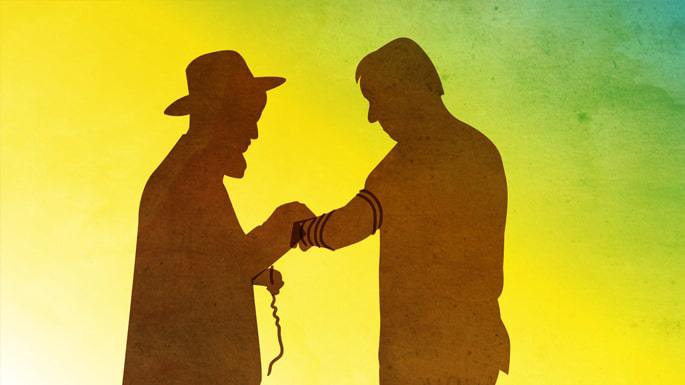
It was here at Chabad of Mobile, after 65 years of life, that I connected with the mitzvah of tefillin.
In the quiet moment, after purposefully wrapping the leather straps and saying the Shema, the rabbi asked me to share a private prayer. It is there I discovered something I had avoided for decades. While prayer might sometimes drift into abstract thoughts or flights of fancy, binding tefillin does the opposite: it grounds me. It brings me back to the earth, reminding me precisely where and who I am.
During that silent prayer, I stand in a foundational truth. I am a Jew.
There is a symmetry here I did not plan. The man I could not understand on a public access channel 40-plus years ago was the one who launched the worldwide tefillin campaign in 1967, days before the Six-Day War. Here in Mobile, at 65, the mitzvah found me.
There has never been a moment where Judaism and I were distant. In fact, far from it. However, practice and I have come in and out of each other’s sphere several times over the decades.
Approach and retreat. Approach and retreat. Like water washing the beach and receding, observance and I have come close then drifted apart.
I truly wish I had experienced Chabad sooner. Perhaps those periods of retreat might have been shorter and the distance between me and observance less. Of course I cannot know what might have been. But here, now, in the practice of tefillin there’s no gap at all.
Thank you, Chabad. Thank you, Rabbi Goldwasser, and thank you to the force of nature thundering through a snowy black-and-white television so many years ago.




Perry My name is Floyd Chodosh & I live in Southern California originally from New Jersey spent a lot of time at my Aunt’s house in Brooklyn on Berriman St. by New Lots Ave took the subway & got off at New Lots Ave, Is any of those names familiar?
I can't say that they do. I was born in Canarsie - we moved to Queens when I was no older than 4. The house in Canarsie was across the street from what became Canarsie High School - it was being built when we lived there.