


Question:
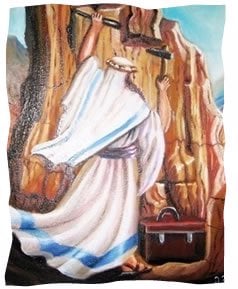
After G‑d forgave the people of Israel for the sin of the golden calf, we read in the first verse of Exodus 34, “The L‑rd said to Moses: ‘Hew for yourself two stone tablets . . . and I will inscribe upon the tablets the words that were on the first tablets, which you broke.’”
Later, we read in verse 28, “He was there with the L‑rd for forty days and forty nights . . . and He inscribed upon the tablets the words of the covenant, the Ten Commandments.”
How can I reconcile these two verses? Who wrote them, G‑d or Moses?
Answer:
Very good question.
The commentators to verse 28 explain that the verse needs to be broken into two parts. In the first half of the verse, “he” refers to Moses. However, in the second half, where we read about the inscription, “He” (note the capital “H”) is a reference to G‑d.1


Rabbi Meir Simcha does not doubt that the inscription on the Second set of Tablets was done by G-d, but explains a peculiarity in Torah language about this, implying that Moshe took some part this inscription, apart from hewing these Tablets. Still, it would be appropriate to clarify if this explanation is based on an established rabbinic tradition, or is it a chiddush (novelty) of Rabbi Meir Simcha?