


We’re coming into a bliss year. Why? Because it’s going to be a very unique year, one that occurs only three or four times in a lifetime. It’s a year that begins with Shabbat and ends with Shabbat.
For this to happen, you need a very big year—55 weeks, to be exact. Because not all Jewish years are created equal. There are years of 353, 354, 355, 383, 384, and 385 days. Only the full, 385-day year is evenly divisible by seven. And so whatever day of the week it starts on, that’s when the next year will begin.

Only that Shabbat is different. We always add some of Friday onto Shabbat—at least a few minutes before the sun goes down. Technically, those days are going to belong to the year before. So now, you’ve got a Shabbat Sandwich year: Shabbat at the top, a little bit of Shabbat at the bottom, and all the other days of the year sandwiched between them.
As the Rebbe pointed out1 the last time this happened: Everything within this year is enveloped within the aura of Shabbat from top to bottom. And what’s Shabbat? Enjoyment. Pleasure. Bliss.
“Hey,” you say, “I gotta go to work. I gotta get my grades. As much as I’d like to, I can’t spend the next 55 weeks of my life blissing out.”
I hear you. So here’s the deal: Just kick it off with bliss and enjoyment, and the rest of the fun will follow.
The kick-off of a Jewish year is Rosh Hashanah, so let’s look at that. We can do this.
How Do We Do This?
Rosh Hashanah is also called The Day of Judgment. What’s so blissful about judgment?
It all depends on how you sandwich it. You can sandwich the entire day—challah, wine, apple, honey, and cinnamon-raisin kugel included—within thick, bitter slices of judgment. Not a happy combo. Or you could sandwich some spicy judgment within the blissful pleasure of Shabbat. Very happy combo.

You could say, “On this day, G‑d scrutinizes the portfolio of every single one of His creations. I’m supposed to go before Him and plead the case for a good, sweet year. And I’m just another of those (rather culpable) creations! I’m supposed to sit at a meal and enjoy myself?”
Or you could say, “What an amazing privilege! This puny meat-patty with eyeballs gets to plead the case for the entire universe before the Infinite Isifier of All Isness! I get to call Him ‘our King’ and ‘Dad.’ We’ve got some real deep connections happening here. L’chaim to that!”
The absolute expert on Blissful Judaism was and still is Rabbi Israel Baal Shem Tov. Here, too, he has a great tip for us—in the form of a parable:
A king sat upon his throne receiving petitions from his subjects. One poor man stood before him and sobbed profusely, kvetching in a painful voice about his misfortune and pleading for the king’s mercy.
The king turned to his attendants and said, “These bad vibes are wrecking the whole mood of the palace. Find out what he needs and get him out of here.”
Next, another subject came before the king, his face aglow with joy and awe. He spoke about what a great privilege it was for a shmendrik like him to stand before his king, such a great king, one who cares so much for his subjects. He was practically dancing with glee and excitement.
The king turned to his attendants and said, “Give this guy whatever he asks for. And bring him back more often. We need more of his radiance and joy in this palace!”2
Heaven Is Fun
Heaven is a fun place, like it says, “In His place, there’s strength and joy.”3 And where is Heaven? Wherever you make it. When G‑d created the world, He didn’t kvetch about it. He delighted in it. He said, “It’s good! It’s sooo good!”
And so too, when it comes to making an inventory into what’s going on in this world, He’s not looking to zap His creatures. He’s looking to get some joy out of them—what we call nachas.
Be that joy. Give Him some nachas. Tell Him, “Look, I know I haven’t let You into my life very much this year. So let’s get to work on patching that up. How about we start with meeting up on occasion? Like, I could [light a candle before Shabbat] [wrap tefillin in the morning] [buy kosher meat] [turn up to a regular Torah class] [place some other mitzvah here].”
You think that’s a small thing? To Him, it’s huge. It’s like a lost child calling home and committing to regular visits. What a celebration!

Shofar Bliss
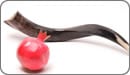
That’s actually what blowing the shofar on Rosh Hashanah is all about.4 The Kabbalists say it awakens divine bliss. It’s a message to G‑d that there’s plenty of enjoyment He can take from His world. His children are doing mitzvahs. They’re calling out to Him. They’re coming home!
That also explains why we don’t blow the shofar when Rosh Hashanah falls on Shabbat—not until the next day. Why not? The practical reason is that some people might carry a shofar in the street, which is forbidden on Shabbat. But there’s a deeper reason: The shofar is redundant. G‑d is already enjoying Shabbat.
Shabbat is the day when, like the very first time, G‑d sort of sits back and…well, He doesn’t sit, and He doesn’t have a back. But He withdraws His energy from the humdrum of the universe and relates to it in a very different way.
For six days, He’s invested in the nature of things, in putting on a show as though this world were something separate from Him—what they call in Hollywood “sustaining suspension of disbelief.” On Shabbat, He pulls back into oneness mode—just chillin’ out and enjoying “what an amazing world I got out there! Look at the wonderful things some people are doing. That’s just what I created it for!”
We do our best to resonate with that modality. We rip ourselves away from the chaos of this fragmented world and its meshugana devices that ring, vibrate, hypnotize, tug and pull us in hundreds of directions at once. And we plug into the serene oneness of divine communion, the sweetness of song and prayer, and the yumminess of cinnamon-raisin kugel—sans devices.
Basically, everything the shofar is meant to accomplish, Shabbat is already doing—and more. G‑d is already enjoying His world to the max.
So why not enjoy it with Him?
And once you’re done with that, don’t stop. Enjoy the whole year giving Him nachas, learning Torah with Him, celebrating His mitzvahs and the embrace of His closeness, and just blissing out together.










Start a Discussion