


In Parshat Lech Lecha, after Abraham's victory in the battle against the invading kings who had captured his nephew Lot, we encounter the mysterious character of “Melchizedek, the king of Salem.”
And Melchizedek the king of Salem brought out bread and wine, and he was a priest to the Most High G‑d. And [Melchizedek] blessed him, and he said, “Blessed be Abram to the Most High G‑d—Who possesses heaven and earth—and blessed be the Most High G‑d, Who has delivered your adversaries into your hand.” And [Abram] gave him a tithe from all.1
This encounter raises a number of questions. Firstly, who is this Priest-king serving the same G‑d as Abraham? How did a Canaanite king know of Hashem? And why does Abraham give him a tenth of all his booty?
Who Was He?
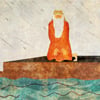
Scripture itself gives us no backstory for Melchizedek, but the Oral Torah fills in the blanks. According to an ancient tradition recorded in the Targumim2 (Aramaic translations) and Talmud,3 Melchizedek was none other than Shem, the son of Noah. Shem survived the Flood and received blessings from Noah. He was the righteous forebear of Abraham, keeping alive the knowledge of G‑d in a world slipping into idolatry.
Shem even established a yeshivah together with his great-grandson Ever, where the Patriarchs would later study.4 The Midrash notes Shem’s exceptional piety: he was so spiritually pure that he was born already circumcised.5 Shem reappears in Avraham’s time as the venerable sage and Priest Melchizedek.
The Midrash explains that Shem/Melchizedek served as a Kohen (Priest).6 Although before the Torah was given, the firstborn of each family would perform priestly service, and, according to Rashi, Japath was Noah’s firstborn,7 still Noah specifically chose Shem for this sacred role, even giving him the clothing made by G‑d for Adam, which represented the clothing of the High Priest. Alternatively, according to the opinion that Shem was the firstborn, he was the default inheritor of this role.8
It was in this spirit that Avraham gave Melchizedek tithes—a tenth of the spoils of war—to express gratitude and honor to Melchizedek as a Priest of G‑d.
Although Melchizedek was the serving Priest at the time, the Talmud9 reads a nuance in the Torah’s words to explain why the Priesthood was transferred to Abraham. Melchizedek blessed Abraham before he blessed G‑d, saying “Blessed be Abram” prior to “Blessed be the Most High G‑d.” Although he meant well, this breach of protocol (placing the servant before the Master) was considered a failing. As a result, G‑d transferred the Priesthood from Melchizedek’s descendants to Abraham’s. As the Talmud puts it, “He [Melchizedek] was a Priest, but his descendants were not.”
Tosafot addresses the obvious question: Wasn’t Abraham also a descendant of Shem? Why would the Priesthood need to be taken away from Melchizedek’s descendants and given to Abraham? He suggests two possible explanations:
1. It means that the Priesthood was taken away from all of Shem’s descendants and given exclusively to Abraham.
2. One can say that since Abraham was not the firstborn among Shem’s descendants, he had no rightful claim to inherit the Priesthood by law; it was therefore given to him specifically, by Divine choice.10
Indeed, Psalms hints at this transfer, addressing the future offspring of Abraham: “You are a Priest forever because of the word of Melchizedek.”11 In other words, due to Melchizedek’s words (putting Abraham first), the Priestly role was given to Abraham’s seed for eternity.
Why the Name Melchizedek?
The name Melchizedek (מַלְכִּי־צֶדֶק) means “King of Righteousness,” and reflects both his role and the place where he ruled. He bore this name because he reigned in Jerusalem, a city known for tzedek (righteousness) and shalom (peace).12 In fact, during the time of Joshua, the king of Jerusalem is similarly called Adoni-Tzedek, showing a tradition of associating Jerusalem’s rulers with righteousness. Nachmanides explains that this title may have been given by the nations themselves, recognizing Jerusalem’s central spiritual stature, or based on ancient knowledge that the city was aligned with the Heavenly Temple, where the Divine Presence (Shechinah)—also called Tzedek—resides.13
Why Mention Melchizedek Here?
Why does the Torah interrupt the narrative between the king of Sodom’s approach (Genesis 14:17) and his dialogue with Abraham (14:21) to insert this encounter with Melchizedek? The Rashbam offers a practical explanation: When Abraham later tells the king of Sodom that he won’t take even “a thread or a sandal strap,” he means he did not benefit from the spoils of war. To validate this, the Torah presents the episode with Melchizedek, showing that Abraham and his men were already sustained by Melchizedek’s bread and wine; they didn’t need the spoils.14
Chassidic teachings explain why Melchizedek specifically offered bread and wine: The third Chabad Rebbe, Rabbi Menachem Mendel of Lubavitch, known as the Tzemach Tzedek, notes that the phrase “brought out” (הוציא) alludes to spiritual dissemination: he “brought out” Torah to the world. Bread represents the revealed aspects of Torah, while wine hints at the inner, mystical dimension.15

Eureka! I finally figured out the mystery of Melchizedek. I hope you can publish this comment. The key to understanding the inclusion of Melchizedek in biblical texts is to know its metaphorical meaning in Hebrew. "King of Righteousness" becomes a plurality as "Kings of Righteousness" when applied to all those who came after Abraham as kings; therefore, naming someone to be a priest in the order of Melchizedek is to name that person a "king of righteousness." David becomes by the statements in Psalms 110 a "king of righteousness" forever. It gives clearest proof ever that the Moshiach will be a descendant of King David and be a priest in the order of Melchizedek forever because the Moshiach will be the next king of Israel and a king of righteousness! I love this stuff.