Printed from Chabad.org
Contact Us
Visit us on Facebook
Meet the new Chabad.org
Switch to OLD version

17th of Tammuz: History, Laws and Customs

The day Jerusalem’s walls were breached

Print
E-mail

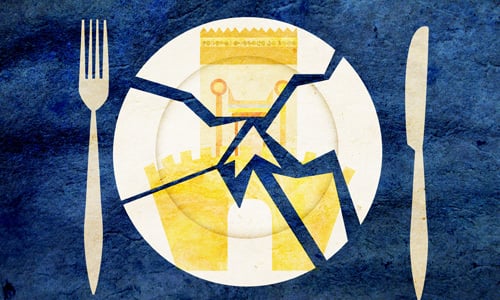
The fast of the 17th of the Hebrew month of Tammuz, known as Shiva Asar B’Tammuz, is the start of a three-week mourning period for the destruction of Jerusalem and the two Holy Temples.

The fast actually commemorates five tragic events that occurred on this date:

  1. Moses broke the tablets when he saw the Jewish people worshipping the Golden Calf.
  2. During the Babylonian siege of Jerusalem, the Jews were forced to cease offering the daily sacrifices due to the lack of sheep.
  3. Apostomos burned the holy Torah.1
  4. An idol was placed in the Holy Temple.2
  5. The walls of Jerusalem were breached by the Romans, in 69 CE, after a lengthy siege. (Three weeks later, after the Jews put up a valiant struggle, the Romans destroyed the second Holy Temple on the 9th of Av.)
    The Jerusalem Talmud maintains that this is also the date when the Babylonians breached the walls of Jerusalem on their way to destroying the first Temple.

Practically speaking:

  • Healthy adults—bar- or bat-mitzvah age and older—abstain from eating or drinking between dawn and nightfall. Click here for exact times in your location.
  • Pregnant and nursing women may not have to fast. Someone who is ill should consult with a rabbi. Even those exempt from fasting, such as ill people or children, shouldn’t indulge in delicacies or sweets.
  • A fast day is an auspicious day, a day when G‑d is accessible, waiting for us to repentIt is permitted to wake up early before the fast begins and eat, provided that prior to going to sleep one had in mind to do so.
  • During the morning prayers we recite selichot (penitential prayers), printed in the back of the prayer book. The “long Avinu Malkeinu” is recited during the morning and afternoon prayers.
  • The Torah is read during the morning and afternoon prayers. The reading—the same for both morning and afternoon—is Exodus 32:11–14 and 34:1–10, which discusses the aftermath of the Golden Calf incident, how Moses successfully interceded on the Israelites’ behalf and attained forgiveness for their sin. After the afternoon Torah reading, the special fast-day haftarah, Isaiah 55:6–56:8, is read.
  • During the Amidah prayer of the afternoon service (Minchah), those who are fasting add the paragraph Aneinu in the Shema Koleinu blessing. (It is also added in the cantor’s repetition of the Amidah both in the morning and afternoon services, as its own blessing between the blessings of Re’eh and Refa’einu. Additionally, the priestly blessing is also added in the repetition of the Amidah in the afternoon service.
  • If the 17th of Tammuz falls on Shabbat, the fast is postponed until Sunday. Click here for more about this Shabbat.

Abstaining from food and drink is the external element of a fast day. On a deeper level, a fast day is an auspicious day, a day when G‑d is accessible, waiting for us to repent.

The sages explain: “Every generation for which the Temple is not rebuilt, it is as though the Temple was destroyed for that generation.” A fast day is not only a sad day, but an opportune day. It’s a day when we are empowered to fix the cause of that destruction, so that our long exile will be ended and we will find ourselves living in messianic times—may that be very soon.

FOOTNOTES
1.

Historians have long debated when this occurred: some maintain that Apostomos was a general during the Roman occupation of Israel, while others contend that he lived years earlier and was an officer during the Greek reign over the Holy Land.

2.

This event is also shrouded in controversy: some say that this too was done by Apostomos, while others say that this was done by King Manasseh of Judea.

The content on this page is copyrighted by the author, publisher and/or Chabad.org, and is produced by Chabad.org. If you enjoyed this article, we encourage you to distribute it further, provided that you comply with the copyright policy.
Print
E-mail
Sort By:
Discussion (15)
October 26, 2012
name of the month
Hi Yisroel
I've been interested in the origins of the names of jews months etc for quite some time. I understand your answer and based on what you said regarding the jews useing the name "tammuz for the name of a month prior to it becomming the name of a pagan God", it maes good sense. Can you substansiate that this timing is actually the case?
Regards
Anonymous
Eleebana, Australia
July 23, 2012
Re
The simple answer is that But the name was used by Jews as the name of a month before it was used for idolatrous purposes, it was kept on being used. For as our Sages said: “Should G-d destroy His world because of fools?” — Should the name of the month be changed just because some people use it for the name of an idol?!

See this article for a deeper explanation given by the Rebbe.
Yisroel Cotlar
Cary, nc
July 20, 2012
17th of Tammuz
I understand why Jewish People would want to mourn all of the above events, for I am sure they brought great sorrow and distress to all. However, I do not understand why they call it the "Fast of Tammuz" since that name belonged to a goddess they called "Queen of Heaven" whom they worshipped by burning incense and poured out drink offerings and made cakes unto her (see Jeremiah 44:1-30) which YHWH stated they were NOT to Worship!! So why do they continue to use her name???
Miriam
Houston, TX
July 16, 2012
The 17th of Tammuz
Religion or faith is like a double edged sword, it can be used to give comfort in a time of distress, but also as a mean of explaining our inner defaults, in the context of our relation with the Supreme Being.; for peace but also in its misuse for war.Only Judaism knows well enough the fine balance between the two in view of its millennial history.
Rafael Segura i Garcia
Valencia, Spain
July 8, 2012
re:Thanks
I would suggest that people who would like to learn more about Judaism and its practical observance, especially people like myself who were not born into an observant home should in addition to using this beautiful website, contact the nearest Chabad Rabbi who will be very happy to help them in any way that he can. In general, he and his family are sincerely dedicated to further Jewish observance in every way.
Shmuel Baron
Baltimore, MD
July 4, 2012
Thanks!
This article was very helpful to me!!! I was born with Jewish blood, yet my parents know nothing about Judaism :( , so I'm teaching myself!!! So thanks a bunch for posting this article! I plan on fasting this Sunday!
Renny
Atlanta, Georgia
July 19, 2011
THANK YOU FOR THE ENLIGHTENMENT
As a person who was born into Judaism by birthright, but who hasn't learned enough to know all the laws, special days, etc., I most certainly respect and appreciate all the information you have provided on the 17th of Tamuz fasting period and the symbolism behind it all. This is how I learn and providing such indepth and appropriate information is so much appreciated. Thank you and may Hashem bless each of you for sharing!
Anonymous
San Benito, TX/USA
July 19, 2011
Why Did the Temple Fall
Connecting to Bruse's comment and the several Prophets who have said, "He does not want your sacrifices". I'm sure for many sending money for sacrifices was enough for people to feel they had atoned 'properly' that their spiritual obligation was completed; rather than all the inward really hard work of transforming ones own soul and outter character. The modern day equivalant is charity to righteous causes. How many of us still feel our work is done once we write the check or press the submit button?
Anonymous
Blue Ash , Oh
chabadba.com
January 21, 2011
Why did the Temple Fall?
According to The Ramban (Nachmonides), the Jewish people did not tolerate their sages, scholars and rabbis to use their good judgment in expanding the reach of the Torah, opting instead for a strict adherence to its letter, spurning its spirit. To avoid a repeat of this we must be on guard to make sure equity or sympathy always combines with the meting out of justice.
Bruce
Hackensack, NJ
July 5, 2010
The Idol of the calf
Sounds pretty scarry about the whole golden calf idol thing.
I think I would want to make sure there were no idols in my temple so my walls wouldn't get breached by the enemy.
Loretta Ruth McCutchen
Charlotte, NC
Show all comments
1000 characters remaining
Email me when new comments are posted.
FEATURED ON CHABAD.ORG