


ב"ה
Ten Days of RepentanceKnowledge Base » Calendar, The Jewish » Ten Days of Repentance
|
|
|
Only showing results in "TheRebbe.org" | Show All
|
|
|
Sort by:
|
|
|
Ten Days of Repentance: The first ten days of the Hebrew month of Tishrei, beginning on Rosh Hashanah and culminating on Yom Kippur.
Teshuvah - Return Not Repentance
Two Different Dynamics The ten-day period beginning with Rosh HaShanah and climaxing on Yom Kippur is referred to as Aseres Yemei Teshuvah (“the Ten Days of Teshuvah”). Cf. Rosh HaShanah 18a. At this time of year, our service of G‑d is primarily directed ...
The following talk by the Lubavitcher Rebbe is about the difficulties of translation itself. The act of translation assumes that for every word in one language, equivalents can be found in another. But this may be untrue, especially when we are dealing wi...
The conventional translation of teshuvah is “repentance.” A more literal meaning of the word, however, is “return.” Repentance is a concept understood by Western society. Teshuvah, “return,” is a uniquely Jewish term. The difference between the two is mor...


Regarding the Ten Days of Repentance between Rosh Hashanah and Yom Kippur, Isaiah the Prophet states: “Seek G-d when He is found, call to Him when He is near.”
The prophet Isaiah declares: “Seek G‑d when He can be found, call to Him when He is near.” The Talmud explains: “This refers to the Ten Days of Repentance between Rosh Hashanah and Yom Kippur.”
6 Tishrei, 5733 · September 14, 1972

The first ten days of the year, beginning with Rosh Hashanah and ending with Yom Kippur, are called "the Ten Days of Repentance." But the commentaries liken the seven days between Rosh Hashanah and Yom Kippur to Chol Hamoed - as if they were intermediate ...

“Seek G-d when he is found, call Him when He is near.” Our sages teach that this verse refers to the Ten Days Between Rosh Hashanah and Yom Kippur, when our repentance is especially effective and accepted immediately by G-d.
The Ten Days of Teshuva is given to us to enable us to atone and repent for any wrong deeds accounted for during the previous year, and to better our way of life in the new year.
A 1981 feed of a gathering in honor of Rebbetzin Chana's yahrtzeit
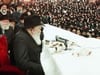
Footage from the Rebbe’s 1981 gathering (Tishrei 6, 5742) commemorating the yahrtzeit (anniversary of passing) of Rebbetzen Chana Schneerson, the Rebbe’s mother.
The marriage of Isaac and Rebecca symbolizes the marriage between G‑d and the Jewish people, a marriage which is renewed every year during the High Holidays.
| |
|
|