


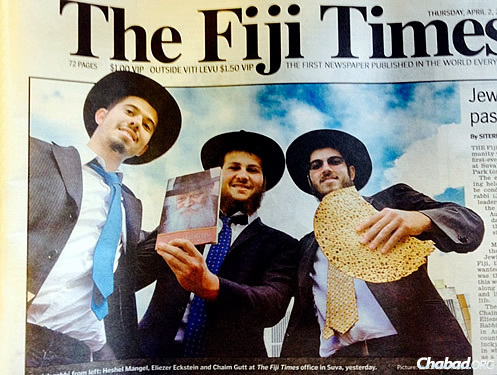
Everyone has a story to tell on Passover, and the Jewish people arrayed around the seder table in Fiji this year were no exception. While Chabad-Lubavitch “Roving Rabbis” have visited this South Pacific island several times in the past—and even printed a Tanya there—this was the first time they arranged a Passover seder for the local community. (The Israeli embassy has hosted seders for staff and visitors from Israel there in the past.) The following is a conversation with Heschel Mangel, a Cincinnati native and senior student at the Rabbinical College of Australia and New Zealand, who visited the island together with students Eliezer Eckstein, of Hollywood, Fla., and Chaim Gutt of Melbourne, Australia.
Q: So, who attended the seder? Were they native Fijians? Where did they come from, and how did you meet them?
A: None of the people who came to the seder are native Fijian. Unless they are of the Lost Tribes, I don’t believe there are any native Fijians who are Jewish. However, four of the people who celebrated with us do live permanently in Fiji. One fellow, our main contact before we came, a 75-year-old named Peter, came to Fiji almost 40 years ago. He noted that “something keeps stopping him from leaving.” He grew up in the United Kingdom with no Jewish upbringing, and this was actually the first seder he has ever been to!
Peter told us how some “Roving Rabbis” came to Fiji 10 years ago, and he purchased a pair of tefillin from them, which he has put on every day since. He now has a mezuzah as well, and we gave him a siddur (prayerbook), in which he already marked the pages for “Tefillin” and “Shema.” He was very moved by the whole experience, especially to be together with other Jews. He took down a couple of their numbers, and they hope to stay in contact with each other.
Another guest at the seder moved to Fiji 12 years ago as a scuba-diving instructor. His parents are Holocaust survivors. He talked about how his grandparents perished in a ship from Europe to Israel, and his parents never spoke about their Judaism. It was actually after he moved to Fiji that he started to get to know more about his heritage, as he went on a mission to find the remains of that ship. While here, he has always been in contact with Jews who pass through. When the “Roving Rabbis” came 10 years ago, he came to their event. He was also a witness at one of the rare Jewish weddings in Fiji.

From the other end of the world, we were joined by an 18-year-old named Nellie from Washington, D.C., where she knows Rabbi Levi Shemtov of American Friends of Lubavitch (Chabad). She is here volunteering on a different Island in Fiji. She tracked us down through the Chabad.org seder directory and made the flight to our island to join us for the seder. She lit holiday candles for us all and was very involved in the seder since she reads Hebrew fairly fluently, and knew all the classic Pesach songs. Of course, there were some Israelis as well, including an older Israeli man who lives in Australia and is in Fiji helping out his son with his business.
Another Israeli came to the seder due to the following series of events: We were featured on the front page of The Fiji Times with a picture of us, and an article about why we came and what we hoped to accomplish. That day, a fellow approached us in a supermarket saying that he saw us in the paper. We asked him if he was Jewish. He replied that he is not. After a moment, he told us that he knows someone who is, and he gave us this Israeli man’s phone number. We contacted him right away, and he was very excited to be able to speak to us in Hebrew. He drove nearly four hours to join us at the seder. He was a classic Israeli, with a great sense of humor. He absolutely loved the seder. He made the environment that evening, keeping the conversations flowing, telling stories of when he was in the army and generally entertaining us all. He also came early enough to wrap tefillin before Yom Tov.

And, as you’d expect, there was a backpacker who had finished the Israeli army a year ago and has been on vacation ever since. He had posted on an Israeli forum that he was looking for a seder. Someone put him in contact with Rabbi Mendel Kalmenson, who was here years ago, and Rabbi Kalmenson connected him with us. He also drove from many miles away, and contributed greatly to the singing and reading at the seder.
Of course, there were many other people whom we met who were not able to attend because of distance or other logistical reasons. We made sure to supply them with shmurah matzah, wine, Passover guides and whatever else they needed to hold a seder of their own. In fact, we know of a trio who held their own seder using those supplies.
Q: The logistics of arranging a seder on a remote island must have been difficult. Where did the food come from?

A: Almost everything other than fruit and vegetables came with us from Melbourne. We had a lot of help from a local Christian woman who loves the Jewish community. She was instrumental in locating a hall for the seder and making many other arrangements. In fact, she treasures a Tanya that was printed here many years ago. But we were really on our own for many things since the previous “Roving Rabbis” had never been here for Passover, and we had no precedent to follow for making a seder here.
Q: What kind of response did you get from native Fijians who saw you?
A: People were very, very welcoming, and curious about us, about Jews and about what we’re doing here. We had outfitted our car into a mini “mitzvah mobile” with signs announcing the seder, and we were on the front page of the paper, so it was pretty hard to miss us.
In fact, we held a special event for the non-Jewish community in which we were able to answer their questions about Jews and Judaism. The main theme of the evening was promoting the Seven Universal Noahide Laws, and it was really very successful, with nearly 100 people in attendance.
All in all, we distributed thousands of cards with information on the Noahide Laws and tried to present Judaism in the very best light.







Join the Discussion