


Shemot
Dear Friend,
This week we begin reading the Torah’s description of the subjugation and suffering of the Israelites in Egypt. Since it rarely rained in Egypt, the Egyptians worshiped the Nile River, which was their primary source of water. In an attempt to quash any chance of freedom for the nascent nation of Israel, the evil Pharaoh decreed that all the newborn male children be drowned in the rushing waters of the Nile.
Pharaoh is now dead. But, perhaps without realizing it, we may be drowning our own children in a Nile of our own creation, by throwing them into the fast-paced rat race to prosperity, where the deity of Money is worshiped above all else, and the mores of instant gratification are a close second.
If this is indeed the case, instead of drowning them in the waters of the Nile, let us better immerse our children—and ourselves—in the lifegiving waters of Torah, whose “ways are pleasant and whose tributaries are peace.”
Baruch S. Davidson,
on behalf of the Chabad.org Editorial Team

Before they could become G-d’s chosen people, the children of Israel had to first undergo forced servitude in the “smelting pit of Egypt,” primarily in the manufacture of bricks. Why bricks?

Interestingly, according to Jewish law and tradition, it is preferable that a person walk around with some separation between the foot and the ground. It was not so, however, when one was present in the Holy Temple in ancient Jerusalem . . .

Moses performed miracles and promised redemption. But things got much worse before they got better. Is history repeating itself?

A chronological overview of the book of Exodus: enslavement, ten plagues, freedom, splitting of the sea, the Torah at Mount Sinai, the golden calf and the Tabernacle.
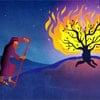
Pharaoh enslaves the Hebrews, and orders all male babies killed. Moses is born, placed in a basket on the Nile, and discovered and raised by Batyah, Pharaoh’s daughter. Moses leaves the palace and discovers his brethren’s hardship. G‑d appears to him in a burning bush, and sends him to advocate for the Israelites’ freedom.

Torah, like any wisdom, has departments. You can’t study literature the same way you study biology, and you can’t critique poetry as you would journalism. So too, you can’t study one department of Torah the same as you study another.

I have a confession to make. Several years ago, when I went bankrupt, I was too embarrassed to tell you my story . . .


My friend’s family is going through a very rough time. She stays home most of the time praying. Should I advise her to stop praying so that she won’t be so angry at G-d?


Education is never going to be the best-paid profession, but I’ve always been excited at the thought of helping people to reach their potential.

Our perception creates our reality. By being calm, we trust that what is in store for us will be positive, and we become solution-oriented rather than emotion-oriented.
What are the spiritual underpinnings of Shabbat that makes it a sacred day of rest? This class explains the deeper understanding of why we rest and celebrate Shabbat.
Why did G‑d create this physical universe? What role does it play in G‑d’s plan? In this fourth of a six-part series on core Jewish beliefs, we discuss why G‑d desires this lowly and crass world, and how the material can ultimately become more G‑dly than the spiritual.
She stood as a model for hours, and everyone envied her. One day, it all changed . . .


Full of memories and experiences of traditional Jewish life in post-war Russia, artist Leon (Chaim Leib) Zernitsky finds expression for his upbringing decades later through his art.
Scientists, rabbis, philosophers and laypeople gather at the Miami International Torah and Science Conference to learn about “Beginnings, Endings & Renewals: Conversations Between Torah Wisdom and Scientific Knowledge About the Universe, Human Life and the Mind."
Rabbi Dov Hillel Klein departed with 41 students for his 30th Taglit-Birthright Israel trip—a record among Jewish campus professionals, and each trip, he says, feels like his first.
For hundreds of years, perhaps since the beginning of Creation, a piece of the world has been waiting for your soul to purify and repair it.
And your soul, from the time it was first emanated and conceived, waited above to descend to this world and carry out that mission.
And your footsteps were guided to reach th...


