


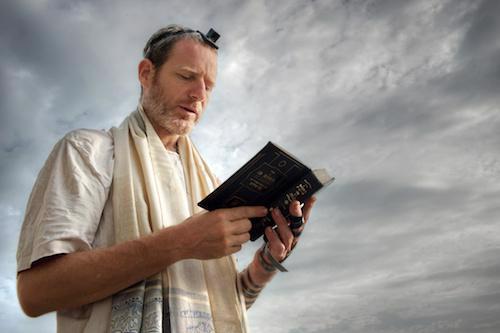
Jewish prayer is a discipline. Don't just wait for the mood to strike.
Prayer is subordinate to study, but taken together, Jewish Prayer and Torah study are the yin and yang of religious life.
The Jewish Prayerbook, the Siddur, did not compete with study for the Jewish soul; rather, it reinforced Torah study.
It was designed to incorporate excerpts from Torah, Mishnah and Talmud, in order to fulfill the Jew's minimum daily requirement of "learning."
The Siddur championed the person's prayer to G‑d for a sharp mind and an understanding heart, elevating it to first place of all the nineteen petitions Jews include in their "Silent Devotion" three times every day.
But the unique Jewish experience of prayer does not come as easily as studying Torah. Praying is a flow and a sway; it evokes a sentiment, a way of relating to G‑d, a priority of concerns, an expression, a mood that is embedded in the soul of the Jew.
However, praying cannot be confined to moments of inspiration or desperation - praying only when one is moved by events and "feels like" praying. Anyone who waits for the mood to strike - a visit to the Grand Canyon, a magnificent twilight, the baby-freshness of a rosy-fingered dawn - is not a praying person, and probably will not be able to pray authentically even when the mood arrives.
One needs to domesticate the stimulus - to make prayer a natural, comfortable event, a day-to-day happening. Jewish prayer is designed to become second nature, a part of a person, a daily diet. In that way, one comes to be on comfortable speaking terms with G‑d, who, in turn, becomes accessible, almost a conversation partner.
Not only is an intermediary between man and G‑d undesirable, it is unnecessary. And G‑d can be found at home as readily as in the synagogue. As the founder of Hasidism once said, "He can be found wherever one lets Him in."
We simply cannot force G‑d to come before people; people need to intrude themselves before G‑d. The Yiddish word for prayer, davenen, derives from the French devant "before," as in "Know before Whom you stand."
Even if we could feel the desire to pray surging regularly from the soul, what prayer would come forth if there were no book of prayers written by great souls, the Siddur?
Perhaps only improvised stammering, well-intentioned simplistic words that last one minute. Improvised prayer is acclaimed today for its spontaneity and subjectivity, but the fixed liturgy of the ages is the foundation of the religious life, and provides the tools with which one may build one's own prayers.
Prayer As An Art
Prayer is an art, yet it can be learned. It requires the mechanical skill of reading (though the words may not be understood) and the spiritual attitude of a willing heart, a sympathetic mind, and an authentic desire to succeed. If pursued with diligence, the result will be well worth the effort invested. Just as a person must practice a learned language to gain and retain fluency; just as an athlete and musician must rehearse daily, rigorously to perform smoothly, so must a Jew pray regularly in order to do so effectively.
The daily diet of prayer consists of morning and evening prayers, Shacharit in the morning, Minchah and Maariv, in late afternoon and evening. On the Sabbath, there is an additional service, Mussaf, added on to the morning. One prayer is central to every worship service, morning and night, weekday, Shabbat, and holiday: the Amidah the "Standing" Prayer, which is also known as the Shmoneh Esrai, the "Eighteen" blessings, or the Silent Devotion.
All prayer speaks of G‑d; the Shmoneh Esrai speaks to G‑d.
It is the peak experience of the prayer service, emphasized by taking three steps backward to withdraw symbolically from your surroundings and three steps forward to symbolically enter the presence of Almighty G‑d. It is recited silently, standing, and occasionally bowing. In all morning and evening prayers, it is preceded by the most well-known verse in the Bible or Siddur: Shema Yisrael, Ha'Shem Elokenu Ha'Shem Echad, "Hear, O Israel, the L-rd, our G‑d, the L-rd is One."
This is referred to affectionately as the Shema. Surrounding these two key prayers are clusters from the classics of Jewish literature: the Torah, the Prophets, the Psalms, and the Talmud.
As a child learns to walk by walking, so we learn to pray by praying. Regularly.
Herman Wouk, in his "This is My G‑d", graphically describes a newcomer to a synagogue service and his confusion as well as the benefits of learning how to pray:
He is handed a prayerbook that strikes him as a jumble, with English translations that, for long stretches, make little sense. He is apt to observe preoccupied and inattentive worshippers reeling off Hebrew with few external symptoms of devotion, or whispering together while a reader chants a long singsong. Now and then, everybody stands, he cannot say why, and there is a mass chant, he cannot say what; or, if he dimly recalls it from childhood, he cannot find it in the prayerbook.
The time comes when the Holy Scroll is taken from the Ark for a parade to the reading desk, the bells tinkling on its silver crown. The reading in a strange Oriental mode seems endless, and he observes that it seems endless to some other worshippers too, who slump in an unfocused torpor, or chat, or even sleep... The skeptic leaves - early, if he can - well satisfied that his views are sound, that his religious fancy was a temporary touch of melancholia, and that, if the Jewish G‑d exists, there is no reaching him through the synagogue...
The newcomer in a synagogue will, of course, feel strange and ill at ease; he will be put off by the matter-of-fact manner of many of the worshippers; he will find the process hard to follow, and he will be an exceptional person not to feel discouragement at first. But persevering attendance, especially linked with any kind of elementary Hebrew training, will in a short time give him back the key to the storehouse of Jewish prayer.
Then, when he wants to, he will pray in the measured and fine words of the tradition; at the synagogue if he can go there, at home if he cannot...
The fact is, prayer is never easy. True prayer is as demanding - at least as demanding - as the carrying on of a business conversation or the writing of a letter. It purports to be a communication with a Listener. The child and the newcomer struggle with their unfamiliarity. Devout worshippers struggle with their over-familiarity. All men of any training or any faith are put to the greatest mental effort, I imagine, to get at any real sense of talking to G‑d.



I do not deny the joy of prayer to those who derive solace or encouragement from it. However, I see no point in prayer. I am a WW2 vet and the sights of the Holocaust made me doubt its value. I am a very enthusiastic practitioner and supporter of Jewish principles, living by Rabbi Hillel's admonition "That which is abominable to you, do not do to others. All else is commentary."
I find prayer of little effect, reasoning that if He ignored the prayers of 6 million of his people., in extremis, why should he take notice of a good, but unspectacular, person, like me.
While I agree with you that the Divine rationale for the Holocaust is unfathomable I don't see how it negates the value of prayer. Prayer is about the individual connecting to G-d; the fact that anyone at anytime is able to forge this connection is in itself amazing and a true kindness from G-d. How G-d chooses to respond is beyond our capacity to comprehend.
rabbi yossi, judaism recquires a minyan to perform certain rituals and prayers. judaism can be expressed when there is a minyan. the letter yud is very important. to connect with ashem you should work to remain inside a minyan, a community. we jews are a people who belong to a community and pray in community and remain loyal to our community. I as many askenazim. am a witness of what happened to all jews who did not listenned to the partisans. I exist because my father worked in community, he did not pray alone, no rumanian could disposse of his life, his best friends (non- jewish) took all he had but not his life. he joinned a jewish community. He knew he had to flee not to stay in rumania and keep praying he did his job so ashem coud do HIS.
My connection to G-d is solid. I live as, he would want me to. I feel it instinctively, The pomp and circumstance of the services may be of great value to many, but I sometimes even feel that it is not religion, but ostentation. may G-d forgive me.
In addition, I am a professional scientist who has written papers, and given talks on the relationship of creation to evolution. I have never been defeated in my argument for creation.
i have mixed thoughts about your resoonse, but, in general it is actually meaningless. The ONLY time the "community" idea worked was when the Jewish community of Warsaw decided to ignore the pacifist element that sent millions to their death, and rise up to fight the Nazis. Had the "community" of Jews done so, in 1933, the Nazis would have never gained the power that almost eliminated ALL Jews in Europe,
Nat. cummunity is a minyan. partisans had communities. They never stop fighting. Partisans, today, belong to a kibutz in Israel. I am witness rumanian non jews could not dispose of my families life. that is the reason I am a witness. They belonged to the Shomer Arzaid and the bund, they all participated in the activities of a minyan, they had a leader for prayer. The community arranged for their departure from Rumania. Jewish communities do work. Lots of jews form part of a minyan community, represenyted by the hebrew letter jud. We keep praying in a community. Moses, the prophet, worked with a community. Yitro tought him so.Jews use their freedom of choise to join a minyan to pray, everyday, YOM YOM.
Nat, the article does not tell you what prayer has to do with a massacre. The assasination of millions cannot be called a Holocaust. It is a massacre a butchering, a slaughter. Please give the editor of this page a chance to find a reason to publish what you write which does not concern to Prayer is an art. I invite you to read the article before you make a comment on prayer as an art.
It is the editor´s duty to keep this page free of distortions,
Nat, Jewish prayer has kept for 5779 years the jews together. Two temples were destroyed in Jerusalem and jews came up with writing the mishnah and keep praying until today. This page tries to show you what jewish prayer is: a discipline. If you have nothing good to say about jewish prayer, say nothing, keep quiet. Do yourself a favor. All of us who take time to read your writings realize you know nothing about jewish prayer and have no desire to learn. Allow the editor of this page do his job. Help him build a kosher and interesting page.
Nat, Jews have shown the world they know when to run to save their lives and when to stay still and pray. Jews have survided 5779 years of persecution. Jews had to work hard to enjoy their freedom. Jews today work very hard to keep our freedom. The 15th of Nissan we will pray to thank ashem for our freedom. While Moses was praying Najson Avinadav was walking to cross the sea of reeds. Jews have always known when to walk and when to pray. One jew prays the others keep walking.
Nat, the art of prayer has nothing to do with non jews who killed jews and blamed nazis in 1933.
The art of prayer has nothing to do with nazis in power.
The pacifist element has nothing to do with the art of prayer.
Your mixed thoughts have nothing to do with the ar of prayer. Keep reading the article. You might understand what the writer is trying to convey. Give the editor a brake.
Nat: religion comes from latin religare which means relate to. Ashem talks to you in your way. In a way you can understand. We jews have space for everyone who decides to be a jew. The only institution who can decide if you are or not a jew is the minyan. Without a minyan it would be dificult to express your judaism and to be interred in a jewish cementery.
Nat, your connection to ashem will always be solid. Your neshama will remain connected to ashem after your body returns to adamah. Get in touch with rabbi Yossi Grossboum, he will take you to someone who can explain you the art of jewish prayer in a way you can understand. The master will arrive only when the pupil is ready. Welcome to the world of jewish prayer. You will never enter jewish prayer unless you realize you are ignorant and decide to start learning. Ignorant people do not ask, they know everything. this page was designed for jews who are willing to learn. Keep trying,
I can feel for your absolute devotion. But, the bible specifically warns, sv stated in simpler terms, by Gershwin "It a'int necessarily, so."
Nat, Bible is also a greek word. Jews write their sacred instructions in rolls made out of tanned unborn calf leather. Christians name the jewish scriptures, old testament. by your comments I gather you are quoting both: the bible, which was written in greek and the old testament, also writen in greek . Rabbi Maurice Lamm´s, the author of the article ; " The art of jewish prayer" neshama, will probably be able to acompany you in your process. His yurtzeit is on the 29th of June. Pray a Kadish in his memory. do not forguet to mention his name on that day. His name is the only thing which remains on earth.