


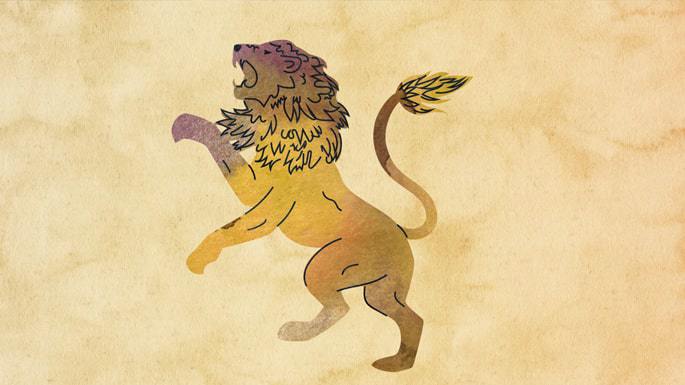
In biblical times, lions roamed the hills of the Holy Land; they were woven into prophecy, poetry, and parable. Our sacred texts abound with them. They represent power, yes—but also yearning and leadership, awe and love. They are the silent guardians of the Temple, the faces in Ezekiel’s chariot, the fire of mysticism, the passion of prayer.
And may we all soon see the day when the lion lies down in peace, when our world is healed, when the final roar is one of redemption.
Judah’s Roar
“A lion’s whelp is Judah. From the prey, my son, you have risen … He crouches, lies down like a lion—and like a lioness, who dares rouse him?”
—Genesis 49:9
It begins with a blessing that feels more like a riddle. Jacob, aged and luminous with prophecy, gathers his sons for a final benediction. To Judah, he gives the image of the lion. Young and rising, fierce and still, its strength is in restraint, its majesty in the patience of one who could strike but doesn’t.
This is the first lion in the Hebrew canon. Not in the wilds of Canaan, but in the folds of the human soul, evoked in words passed from father to son. And Judah, the fourth son, becomes the one through whom kings will descend—David, Solomon, and in time, the Messiah himself. The lion is more than a metaphor draped upon Judah; he becomes it. The symbol fuses with the substance.
To call someone a lion in ancient times was no small gesture. This creature with no equal was king of beasts long before monarchs were crowned. But in Jacob’s mouth, the compliment is tempered. Judah is not just a lion. He’s a whelp—a cub. The verse places him in motion: From the prey, my son, you have risen. It’s a moral trajectory. Judah, who once sold a brother and broke a father’s heart, later stood in selfless defense of another brother’s freedom. This lion’s nobility is earned.
Moreover, this lion’s strength is not in the hunt but in the crouch. “He crouches, he lies down …” There’s no need to lunge. True power need not prove itself. This image—of the lion at rest, unbothered by challengers—is a template for leadership: poised, measured, conscious of its weight.
The lion would go on to become the emblem of the tribe of Judah, stamped on banners, etched into sacred art, and sung into the hearts of generations. It roars from the crest of the Jerusalem municipality to this day.
One might say that all of Jewish history is an echo of that roar. Not the loud kind—but the kind you feel in your chest. A low, slow rumble that says: We were, we are, we will be.
David and the Lion’s Courage
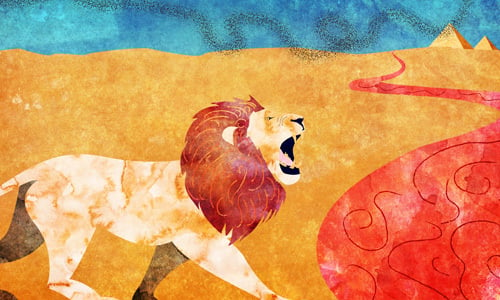
Before David was king, before harp or psalm or crown, he was a boy in a field with sheep. Not exactly where one expects to find the Messianic line taking shape. But in our sacred texts, greatness rarely arrives in royal robes—it shows up in the wild, with danger close behind and courage unannounced.
David’s first lion is no metaphor; it is memory. When Saul questions the young boy’s absurd willingness to fight a giant, David answers: “Your servant used to tend sheep for his father, and if a lion or a bear came and carried off a sheep from the flock, I would go after it …”1
It’s a quiet kind of astonishing. David doesn’t claim to be fearless. He simply describes a boy who, when something precious was taken, got up and ran toward the danger. Not for glory. For a lamb.
The lion here isn’t the noble emblem of a tribe—it’s a threat. And yet, it becomes the training ground. Before David could face Goliath, before he could ascend the throne or pen the psalms that would shape prayer for eternity, he had to face a lion in the fields. No witnesses. No applause. Just a boy, a predator, and a decision.
Here was a future king who didn’t just protect his sheep—he pursued the thief. And it was this pursuit, this refusal to be paralyzed by fear, that made him fit to lead. It wasn’t strength that defined him but moral instinct. The lion helped prove his fitness, not because he conquered it—but because he didn’t hesitate.
Later in the arc of David’s life, the lion returns. In Psalm 22, he writes: “Save me from the lion’s mouth”—not just an animal, but a metaphor for forces that devour. Here, the lion becomes the weight of existential dread, enemies real or imagined, the howl of suffering that seeks Divine reply. Even in kingship, even in closeness to G‑d, the lion can still be terrifying. The courage is not in being unafraid, but in turning fear into prayer.
In David, the lion’s image matures. From external challenge to internal reckoning, from predator in the brush to the shadows of the human soul. It is never entirely tamed—but it is met, and named, and answered.
David’s courage goes far beyond battlefield bravery. It is the courage to weep, to err, to rectify. To rise when shamed, to sing when broken. The lion in David’s life is never entirely behind him. It waits at every chapter. But so does the shepherd’s sling and a heart that never stops rising.

The Lion of the Temple: Sacrifice and Fire
There was a time when lions consumed offerings. According to the Talmud, in the days of the Temple, a lion of fire would descend from heaven to devour the sacrifices placed upon the altar.2
The Sages speak here of something seen. A Divine flame, shaped like a lion, licking up the offerings with otherworldly appetite. Majesty, power, a symbol made animate by fire.
The lion of fire, they say, was a sign that the sacrifice had been accepted. Heaven’s nod. G‑d’s RSVP. When the lion came, it meant the offering had risen in purity and the people had drawn near.
This might raise a theological eyebrow. The Creator of galaxies expressing favor through the image of a wild beast? And yet in sacred logic, it fits. The lion, long associated with strength, awe, might—here its power is used to elevate what we have to offer.
Rabbi Eliezer in the Talmud adds an arresting detail: In the First Temple, the fire appeared in the shape of a lion; in the Second Temple, it appeared as a dog. The fire still came, but it had grown smaller, less regal. The Divine presence had dimmed, even as the rituals continued. Holiness was still present—but much diminished. A lion cannot be faked. But a dog, sadly, can be trained.
There’s a quiet pain in that shift. We lost the lion. We kept the flame.
But perhaps that too is part of the Jewish story. We are the people of the invisible fire, continuing even when the lion no longer roars. The memory of that lion—a flame that once leapt heavenward and returned in majesty—lives on in our hopes and our dreams and our striving.
In the words of the Zohar, the sacrifices were not simply offerings but “It’aruta d’Letata”—“awakening from below,” acts that stoked Divine response.3 The lion of fire was more than a sign that G‑d had accepted the gift. It was G‑d meeting our ascent with His own descent, approaching us in flame and form. It was intimacy.
And though the Temple stands no more, every prayer, every act of compassion, every moment of self-transcendence, is offered into that same invisible fire. We are no longer spectators of lions; we are meant to become them.
The Four-Faced Chariot
The lion appears again—but this time, not in a field or forest. This time, it burns in heaven.
Ezekiel’s vision, hovering over the river Chebar in today’s Iraq, becomes a template for mystical experience. The sky shatters. Fire whirls. Wheels turn within wheels. And in the heart of it all: a throne, a chariot, and four great faces. “Each had the face of a man … each of the four had the face of a lion on the right, the face of an ox on the left, and the face of an eagle.”4
Here is something as significant as it is unexpected. The lion is placed on the right side, the side associated with Divine kindness, the outpouring of generosity that begins all things. In the symbolic map of the soul, the right side is where love lives.
This lion is not roaring in rage. It is roaring in love—a blaze of longing that seeks the Beloved without cease. The lion is the soul’s surge toward G‑d, that seeks not to consume but to connect. A holy longing. A love that burns upward.
Its Hebrew name is telling: “Aryeh”—lion—is made of the same letters as “re’iyah,” vision.5 This is love that comes from seeing, from perceiving. A lion that gazes. A lion that beholds. The lion on the right side of the chariot is ablaze with awareness. The clarity of one who sees the Infinite and runs toward it.
In Kabbalah, this lion becomes an archetype. It is the upward motion of the soul—“ratzo,” the running. A love so intense that it cannot rest, a vision so clear that it can’t stay still.
The sacred texts speak of four directions, four faces, four elemental energies. The lion becomes the face of the east—the direction of dawn, of beginning, of opening. The lion is what wakes. And that is love too: the ability to awaken, to see anew, to move from blindness to presence.
But the vision is not only about heaven. In Kabbalah, the lion’s place on the chariot is drawn inward. Every soul contains a lion, a love to awaken. When the heart breaks open in prayer, when a person glimpses something true and can no longer look away, that is the lion speaking.
And it is love, not logic, that gives the lion its fire. The ox on the left marches in obedient devotion. The eagle above soars in refined thought. But the lion charges forward, eyes wide open, flame in its breath. Because it sees. Because it knows. Because it can’t help but run.
The lion in the chariot is an invitation. To see the world more clearly. To love more fiercely.

The Roar of the Sages
“Be mighty as a lion to do the will of your Father in Heaven.” — Pirkei Avot 5:20
By the time the lion reaches the Talmud, he has wandered from the wild into the Beit Midrash, the House of Study. And there, among parchment and argument, he remains very much alive.
In the hands of the Sages, he becomes a model of the spiritual personality—raw, roaring boldness refined into sanctity.
“Be mighty as a lion,”6 says the Mishnah; Rise each morning ready to defy inertia, embarrassment, and spiritual indifference. This is a call to presence. The lion does not ask permission to wake the dawn. He stands. He roars. He moves toward what matters.
And so should we.
In Rabbinic lore, the ones called “lions” are rarely the loudest in the room. They are those who combine courage with care, intensity with gentleness, decisiveness with humility.
In the mystical philosophy of Chassidism this courage becomes mesirat nefesh—self-sacrifice. To speak the truth when it is not fashionable. To rise in prayer when the world feels heavy. To teach when silence would be safer.
The lion’s boldness is not ferocity, but fidelity. A refusal to betray the soul’s mission.
The roar of the sages, then, is a stance. A presence.
Not always loud. But unmistakable.
The Kabbalist Lion
He was called the Ari—the Lion.
Rabbi Isaac Luria, 16th-century mystic of Safed, reshaped Jewish thought. He left almost no writings in his own hand. His teachings were preserved through the faithful ears of his students—the “Gurei ha’ari,” holy lion-cubs—who transcribed the thunder they heard between his whispers.
Every teaching pulses with energy. The Ari’s lion stalks the essence of G‑d, racing through realms of light and fracture, pursuing union with the Infinite across planes most people never glimpse.
To understand why he is called a lion, one must understand how he saw the world.
In the Ari’s teachings, the world begins with absence—tzimtzum—the contraction of G‑d’s light, a rupture that makes space for creation. Into that void came a shattering: vessels broke; Divine light spilled. The cosmic catastrophe, known as Shevirat HaKelim, the Breaking of Vessels, left holiness scattered, hidden, embedded in the material.
What remains is a world of fragments—and a task: to gather sparks. To lift. To mend.
And that is the lion’s work.
The Ari’s lion is about vision. The lion sees the spark in the darkness. Far from fearing exile, it chases it. Devours the husk. Reveals the light. Here is mysticism as the hunt. Sacred, mighty, electric with purpose.
The Ari’s lion is also the lion of chesed. Its fire is love. Love that cannot bear for holiness to remain hidden, for injustice to flourish, for people to suffer. Everywhere we turn, the sparks are hidden. Our role is to free them. A simple act of compassion. A kind word. A smile.
Later, Chassidic masters would take the Ari’s maps and walk them with joy, take his fire and warm the generations. His primal roar became the call that awakens the forest.
His students were his cubs. If we listen closely, we can still hear the echo of their paws—padding through the darkness, searching for sparks.

The Roaring Flame
The lion is not just the guardian of the Temple, the face in the chariot, the tribal banner. It is the part of the soul that burns—hot, insistent, and Divine. This is beyond intellect. It is will, the fire of ratzon—desire for G‑d so pure it bypasses the mind entirely.
The Baal Shem Tov taught that G‑d desires the heart above all else. Not perfection. Not polished knowledge. The heart. The yearning.
The lion of Chassidism is prayer that rises from the deepest recesses of the heart. The cry of the soul that cannot stay quiet anymore. The courage to love G‑d even when you do not understand Him. Especially when you do not understand Him. The determination to love others even when we do not understand them. Especially then.
The lion is holy “ratzo”—the soul’s leap upward in longing. It is about motion. The lion runs, even when there is no clear path. It runs because it must.
But Torah does not idealize escape. The lion’s leap must always be followed by return: “shov.” The descent back into the world. Into our selves. The goal is not to roar and disappear—but to carry that fire into action. To pray like a lion and then listen like a lamb. To burn—and then to build.
Where do we get the fire? We don’t. It’s already within us. We need only uncover it.
This lion is not always graceful. It pants. It weeps. It stumbles sometimes. But it is never lukewarm. Lukewarm is not kosher for lions.
So we return, time and again, to the flame. The lion ablaze with desire, with noble want.
Wanting a world that is good, that is beautiful, that is kind.
And this want pulls the world forward—toward a day when justice is gentle and kindness is crowned.
Written in honor of the bar mitzvah of Dovid Yehuda Leib Kievman



Absolutely Beautiful!