


Welcome
If you are holding this book, chances are that you have some interest in Chassidus. Whether this is your first serious introduction or you have been learning Chassidus for decades, this book is designed with you in mind.
Chassidus is the Torah wisdom which was first taught by the Baal Shem Tov and later developed into an encompassing philosophy and worldview by the seven Rebbeim of Chabad. Clarifying the nature of our relationship with G‑d, the value of Torah and mitzvos, and the depths of Jewish identity, these teachings come together to form a cohesive set of ideals.
In this volume, you will find a comprehensive presentation of this wisdom, focusing on its origins, explaining its primary principles, and elucidating its mission. The ideas are presented with extensive detail and lucid explanation which provide a rich understanding and informed appreciation of the topics.
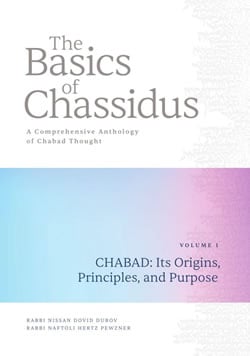
This is the first of a multi-volume series titled The Basics of Chassidus – a Comprehensive Anthology of Chabad Thought.
As the name The Basics of Chassidus implies, the goal of this series is to present a cohesive and accessible body of the wisdom of Chassidus. Just as any library might be equipped with comprehensive works covering “the basics” of various fields, our mission is to provide English readers with an equivalent collection of Chassidus.
In a structured and well-organized manner, we seek to offer the reader a complete picture of Chassidus. This will allow people on all levels of study to enhance their understanding and appreciation of Chassidus’s structure of ideas and day-to-day relevance. Our sincere hope is that this volume and the series to follow will provide this resource.
Organizing Chassidus
The Rebbe’s efforts to amass Chassidus into a single structure began in the 1930s. Seeking to set the stage for a comprehensive encyclopedic collection of Chassidus Chabad, the Rebbe started creating indexes and offering cross-references on classic chassidic texts.
In the years of calm before war started to rumble in Europe, the Rebbe painstakingly began composing indexes on Tanya, Torah Ohr, and Likkutei Torah, the three most foundational texts of Chabad thought. Later, while fleeing from the Nazis ym”sh, the Rebbe continued to work extensively on this project. Years later, in a rare autobiographical remark, the Rebbe noted that “The variances of circumstances of calm and turbulence, safety and danger, caused differences of style within these compositions.”1
After coming to New York in 5701 (1941), the Rebbe was appointed by his father-in-law, the Rebbe Rayatz, to oversee the publication of the full library of Chassidic writings. Here, as before, the Rebbe continued to write indexes and notations seeking to bring this vast collection of teachings into a single unified body.
After assuming the role of Rebbe in 5710 (1950), these efforts intensified. Over the decades since, almost all Chassidic texts have been published with extensive indexes and references.
Nevertheless, the Rebbe sought to further enhance the learning experience and provide a cohesive presentation of Chassidus.
This is what led to the commissioning of Sefer HaArachim-Chabad which the Rebbe saw as the realization of his dream of organizing Chassidus.
As the Rebbe phrased in a correspondence: “I have felt this need for decades, but it has been delayed for many reasons. I began the preliminary work for a Sefer HaArachim decades ago, through creating indexes of the foundational works of Chassidus.”2
What Inspired This Series
The original teachings of Chassidus, as delivered by the Rebbeim, are not organized by topic. Ideas are explored, explanations are offered, and clarification is provided, but not in a single structure. A satisfying “Aha” of clarity often comes after amassing a significant amount of information gained from a wide array of texts and lessons.
Similarly, later chassidic texts often rely on knowledge taught in the earlier generations. Unsurprisingly, though, it is common that a touch of compelling explanation in the more recent works brings an entire idea to life.
The many hundreds of volumes of Chassidus can be seen as an interwoven tapestry displaying a single vivid picture.
In many ways, Chassidus is an accumulative study. The more one learns, the greater the understanding and appreciation. The broader one’s scope of study, the richer the presentation.
In recognition of this dynamic of Chassidus, the seventh Chabad Rebbe took note of the need for an organized presentation of Chassidus. He described how such a composition would allow for a richer learning experience, while also granting wider audiences the opportunity to enjoy these teachings.
As the Rebbe wrote in 5731 (1971): “In Talmudic subjects, there are several compositions which organize information alphabetically or according to topic. More so in halachah, there are numerous such collections that summarize entire areas of Jewish law. Even on the mystical teachings of Kabbalah there are several such works. Only Chassidus lacks such a presentation. Chabad emphasizes that one should truly comprehend the concepts of Chassidus, so that they can be integrated within one’s entire psyche, yet I have not seen even an initial effort in creating such a work.”3
For this purpose, the Rebbe commissioned a chassidic encyclopedia to amass these vast teachings and organize them by topic. It was named Sefer HaArachim – Chabad, and structured in alphabetical order. To date, this chassidic encyclopedia, the life-work of the venerated scholar of Chassidus, Reb Yoel Kahn z”l, who was appointed by the Rebbe to lead this project, consists of nine volumes.
With exhaustive presentation and extensive sourcing, the Sefer HaArachim has had tremendous influence on the furtherance of the study of Chassidus. With topics elaborately structured over hundreds of pages, Reb Yoel exhibited how every detail of explanation offered by the Rebbeim through the generations enhance the full picture of chassidic teaching. A staggering accomplishment, this work was truly one of a kind.
With the earnest desire to further perpetuate the Rebbe’s vision of Chassidus being presented in an organized structure, the present series, The Basics of Chassidus, was conceived. The ambitious goal of this project is to present to the English readership a first of its kind, a comprehensive and organized collection of Chassidus Chabad. In recent years, there has been a tremendous expansion of the study of Chassidus in English, and this work is set to enhance the learning experience of the novice and veteran student alike.
Accessibility
In an effort to make this work as engaging and approachable as possible, we have chosen to forgo the wrappings of the classic encyclopedia format. This series is for the average person, not only for the academically minded.
The first and most striking modification is that ideas are organized by topic, rather than in alphabetical order. This change enables these volumes to be read in a natural flow, with one chapter following the other. By reimagining the wide scope of teachings to be presented in this series in a “by topic” format, we identified a number of key themes upon which to structure the series.
Each volume will be dedicated to a specific field of study and experience. This initial volume focuses on the basis of what Chassidus Chabad is about and is titled, Chabad: Its Origins, Principles, and Purpose. The second and third volumes will cover the scope of Chassidus relating to the study of G‑dliness and the process of creation commonly known as Seder Hishtalshelus. The fourth volume will focus on the dynamics related to Torah, mitzvos, and the Jewish People. The fifth volume will cover the ideas which relate to a Jew’s daily life as illuminated by Chassidus. Following volumes will feature the themes of Shabbos, the holidays, life events, and more.
A second deviation from the traditional encyclopedia format is that the text is not broken into complex numbering systems and fractured subsections. Although it covers a wealth of ideas in a relatively condensed form, it is designed to be fully readable.
Each volume follows a logical trajectory and can be appreciated as a single structure. Nevertheless, the reader can enjoy any individual chapter as a stand-alone piece, as well.
To accommodate the learning process and to make it easier to navigate the book, the chapters are divided into subchapters and smaller segments. A full listing of these sub-titles appears in the Table of Contents.
With G‑d’s help, this restructured encyclopedia will provide the intended benefit. Volume by volume, we hope that the series will provide an organized and accessible presentation of the complete picture of Chassidus Chabad.
How To Read This Book
Notably, each paragraph is saturated with a wealth of information which can serve as a springboard for thought and discussion. Because of this fullness, it is best appreciated not as a one-go read. Instead, a healthy pause between paragraphs or segments may be necessary to properly process each idea.
A unique typographical feature of this work is that paragraphs which are somewhat supplementary to the presentation at hand are indented from the primary margin. This visual distinction further eases the delivery of information in a seamless fashion.
The reader will notice that extensive footnotes embellish this work and provide sources which enable them to further their learning. Due to the vastness of the Chabad library and a wide array of options to reference any particular idea, care has been taken to select sources that the reader will find more accessible. This will hopefully enable the reader to not only find sources to verify the information but also provide the means to expand and deepen one’s understanding of any idea presented. The footnotes also clarify potential questions that may arise during the learning process or share additional insights and anecdotes, enhancing the reader’s appreciation of the topic. Additionally, there are endnotes to the book which provide further context and explanation to specific topics and discussions.
The Benefit of Organic Study
Convenient as this volume may be, it is only a supplementary conversation of Chassidus. It is in no way intended to replace the study of the original teachings of Chassidus as taught directly by the Chabad Rebbeim. Although not codified by topic, it is only by delving into the gems of wisdom as presented in the original teachings and writings of Chassidus that one can appreciate Chassidus for what it truly is. Through studying these raw texts, one can get a glimpse of infinity well beyond these structured presentations. This series is merely intended to present “the basics of Chassidus,” opening gateways of understanding and appreciation for Chassidus.
With this in mind, painstaking effort has been invested into referencing source materials to provide original references, rather than referring the reader to other adaptations. This is to allow the reader to take any topic one step further, learning it directly from the source, within the original teachings of the Rebbeim. Additionally, despite the aim to make this series as comprehensive as possible, inevitably, it cannot be fully exhaustive. To fully appreciate the scope of Chassidus, there is no alternative to organic study. Lastly, despite our best efforts, the information presented here is only a glimmer of Chassidus Chabad that we, the compilers, accessed in our own study of Chassidus. There is no way we got it all.
Our Hope
The vision for this volume and the series to follow is to reimagine the presentation of Chassidus available in English. We hope that this project enhances the understanding and appreciation of the broad scope of Chassidus and its application. Perhaps more than readers will learn about ideas, perspectives will be fostered which will teach us about ourselves as well.
May the toil invested in learning and sharing the wellsprings of the Baal Shem Tov open channels for wellsprings of clarity, connection, and dedication in our lives as we speedily usher in the arrival of Mashiach, when the world will be filled with the knowledge of G‑d4
Sichos in English
11 Nissan 5782 (2022)
The 120th anniversary of the Rebbe’s birth


Start a Discussion