


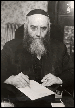
June 1927. A pall of dread hung over the Leningrad apartment of the sixth Lubavitcher Rebbe, Rabbi Yosef Yitzchak Schneersohn. Due to the Rebbe’s efforts to maintain the spark of Judaism in those darkest of times, the Communist regime had rallied its strength against him.
The evil Yevsektsia, the Jewish division of the Communist party, had waged a decade-long battle against yeshivahs, cheders, synagogues, mikvahs, and other symbols of authentic Judaism, and it was now determined to crush one of the last bastions of resistance, the Rebbe.
Dozens of the Rebbe’s closest followers had already been arrested for the crime of spreading Judaism, many of them summarily executed for their ‘sins.’ Spies and informers reported on his every move, and the net of evil was drawing inexorably tighter. His mail was censored; visitors to the apartment were stopped and interrogated. To contact him directly was to risk arrest.
Only a brave or desperate man would voluntarily venture into this atmosphere of danger. It was one such chassid who knocked at the Rebbe’s door late one night. His wife had recently given birth to twins, and mother and children were doing poorly. The infants were barely feeding and his wife was sickly. The frantic father was willing to brave any threat to see his Rebbe and receive a blessing.
Notwithstanding the danger, it was lucky he came when he did, for the very next day the Rebbe was arrested.
For 27 days, Rabbi Schneersohn’s life hung in the balance. Jews from all over the world prayed for his safety and lobbied for his release, while politicians and diplomats made presentations on his behalf. At first it seemed that all the effort was to no avail. Brutally beaten by his jailers, the Rebbe was sentenced to death. Then, through a series of open miracles, and after political interventions at the highest level, on the 3rd of Tammuz 1927, his sentence was commuted to 10 years in the Gulag, a forced labor camp. This sentence was then further commuted to three years of internal exile in the village of Kostrama. On the 12th of Tammuz, just a few days after arriving in Kostrama, he was completely reprieved and expelled from the Soviet Union.
On the day the Rebbe left Leningrad to travel to Kostrama, his jailers allowed him to visit his apartment for a few minutes to see his family and collect a few necessities for the trip. As the injured rabbi was supported into his house to bid his farewells, he had only one concern: “How are the twins and their mother doing?”
That is Ahavat Yisrael, the love for a fellow Jew, and that is a Rebbe.



Start a Discussion