


Making a Difference, One Jew at a Time


We had known for a while that we would be spending Pesach in Peru, but it was only a few days before the holiday that we were informed that our final destination was Arequipa. Our initial reaction was a mixture of excitement and trepidation—through the roving rabbi grapevine, we had heard that Arequipa was a really nice place, but for our purposes, there were only a handful of local Jewish families—Israelis who work in the mining industry living there for a few years at a time. And while droves of Israeli tourists had visited in the past, the current trends were pointing in other directions.
After some discussion, we resolved that we would put our best feet forward and prepare for a Seder for five or ten with the same excitement as one for five hundred. After all, we reminded ourselves, the roving rabbi program is a tribute to the Lubavitcher Rebbe, of righteous memory, who had inculcated his followers in the value of every Jewish soul. Thank G‑d, when we arrived in Arequipa a couple of days before Passover, we already had twenty reservations—on par with the previous years! We ended up having thirty people for the first night and six for the second.
Yehoshua, 19, along with his mother and older brother, was a tremendous help to us before Passover began. They spent several days with us in the kitchen, peeling, chopping, and asking questions. These visits are their sole connection to Judaism, and they were hungry for any morsel of information about their heritage. In previous years, our colleagues had broached the idea of Yehoshua attending yeshiva, but the family hadn’t been ready for such a drastic move. Not anymore! Yehoshua will be traveling to Argentina this summer to begin his yeshiva career, G‑d willing! Meanwhile, he and his mother have enrolled in J-net, where they will be matched with a suitable study partner and learn the Jewish topic of their choice every week via telephone.
Marom moved to Arequipa two months before Pesach. A fellow Israeli expat had connected him with us, and he made reservations for both Seders. After the first Seder, he shyly inquired if he could join us for the festive day meals as well, since he hadn’t been able to procure kosher for Passover food. Of course, we said that we’d be delighted to have him, and we spent most of the afternoon enjoying each other’s company and discussing Jewish concepts. When we headed back home after the first days of Passover, we dropped off a care package of our leftover food, and put him in contact with the Chabad rabbi in Lima so that they could arrange periodic shipments of kosher food to Arequipa.
Tzachi, an Israeli doing his stint in the mines, initially made reservations to attend the first Seder with his family. We were thrilled when he told us late Friday night that he would like to attend the second Seder as well. He was noticeably more involved the second night, singing along and asking questions. Tzachi’s eagerness to learn more about his Judaism was so refreshing to observe! With his permission, we plan on passing along his contact information to the rabbis visiting Arequipa this summer, so that they can continue to help him explore his Jewish identity.
David and Linda, a lovely middle-aged American couple, were checking into a local hotel Friday morning. By Divine Providence, an Israeli family was checking in at the same time, and they struck up a conversation. Naturally, they were soon talking about Passover, and the Israelis invited them to join our Seder. While they were shocked that Arequipa would be host to a Chabad Seder, they said they would be happy to participate. We were pleasantly surprised when they did indeed show up! It seemed like they very much enjoyed the Seder, and meeting all sorts of Jewish people in a place far removed from any semblance of Jewish life.
Last but not least, Jamie, a young man from London doing the popular South American circuit, found us through fellow roving rabbis he had met in Ica. He was dynamic and enthusiastic and really enhanced the second Seder. We hope to have made a significant difference in his Jewish life as well—we connected him with Chabad at Manchester Universities, where he will commence his college studies in a few months.
When we returned to the US, our friends and family wanted to hear all about our experience. Some were skeptical about the need for roving rabbis in a place like Arequipa, where there isn’t the potential to touch a great number of Jews, like Lima, Cusco, or Kathmandu. Still, we firmly believe that we were needed in Arequipa. Numbers may tell part of the story, but the impact one can have on a fellow Jew—when motivated by love for the Torah and love for each other—is truly immeasurable.
Connecting Jamie to a Seder 500 Miles Away

We encountered Jamie in the beautiful sand dunes of Huacachina, Peru, while making our rounds in that popular tourist destination, searching for some Jewish guests to grace our Seders.
“Hey, are you rabbis!?” asked a young man. He approached us, the shock on his face mirroring ours.
“Hi, I’m Jamie from England. I’ve been traveling through South America for the past few weeks. Before I left, I promised my mother I would attend a Seder on Passover, and now it’s two days until the holiday starts and I haven’t been able to find one! Would you be able to help me?”
“Of course,” we responded. “We’ve actually travelled thousands of miles from Brooklyn, New York, so that any Jew in Huacachina will be able to attend a Seder!”
“That’s truly lovely. But my group is leaving town tonight. We’re off to Arequipa for the next few days…”
“Jamie, you won’t believe this!” we said. “Our friends—we all left New York together—are making a Seder in Arequipa! We’ll be glad to give you their contact info. You can let your mother know that come Passover, you will be sitting at a Seder, G‑d willing.”
Five hundred miles away, Shneur Wechter and Mendel Cheruff were preparing for their Seder in Arequipa, another Peruvian tourist hotspot.
“I was in the kitchen preparing the food for the Seder,” Shneur relates, “when I decided to take a quick break to check my phone and see if any Jews needed help finding a seder in Peru, as I had also been tasked with answering all questions on Chabad of Peru’s Facebook page.
“I was surprised that I had received a Whatsapp message from a +44 area code, a UK number, since we had only advertised our Seder in Hebrew. It was Jamie, saying how he had met my friends in the desert and they had told him that we were making Passover in Arequipa. Of course, I invited him to the Seder, included all the pertinent details, and Jamie wrote back that he would be delighted to join us for the second Seder.
“Jamie turned out to be the star of the evening. He followed along in the Hagaddah, and sang all the songs—he truly felt at home!”
“This is my first Seder away from my family,” he told the other participants as they were enjoying the festive meal. “In London, the Seder is a huge event, and my parents—especially my mom—were so upset that I would be missing it. I promised them I would find a Seder, and I tried searching online, but nothing doing. Then, my story takes on biblical proportions! I was in the desert sand dunes, and who do I bump into? Two rabbis! I am so amazed and thankful that I am celebrating Passover here tonight.”
We’re happy to report
that the initial, five minute encounter will continue to have a positive impact
on Jamie’s life. Wechter and Cheruff connected him with Rabbi Eli and Mushka Simon of Chabad at Manchester Universities, where
Jamie will be pursuing his undergraduate studies this fall.
A New Jew in Peru
It was near evening on our second to last day in Peru.
We'd spent the past three weeks travelling the country, visiting the cities of Ica, Huaraz, and Lima. While we sought out the local Peruvian Jews, our main clientele were the multitudes of Israeli backpackers who spend their post-army vacation trekking through South America. We arranged Shabbat meals, helped them put on tefillin, and spent many hours in deep discussion of Jewish philosophy. Our trip coincided with Operation Protective Edge, so we prayed together for their families and friends back home.
We were exhausted. We'd spent the day stopping at all the hostels around Lima where the Israelis congregate, and had the opportunity to meet and talk with many of them. We briefly debated heading back to our hotel before deciding to make a short detour at the local mall, hoping to find another few Jews there. But after strolling around for a while without bumping into anyone Jewish, we agreed that it was time to call it a day. We were approaching the exit when we heard someone call out “Shalom!” At first, we assumed it was a Peruvian, as many of them have picked up some key Hebrew terms from the steady streams of Israeli tourists. We turned around, and saw a gentleman who was clearly foreign, sitting on a bench with his wife and daughter. We greeted them and learned that Dave was from England, visiting family in Peru. “Are you Jewish, Dave?”
“No, I’m not.” We chatted for a bit longer. “You know, part of my family is Jewish, but it was something they kept hidden for a long time.”
“Which part, Dave?”
“My mother’s mother.”
“Dave, you are Jewish! You are a Jew like the two of us, as Jewish as Moses...”
As you might expect, this life-changing revelation left Dave stunned and speechless, but we also got the sense that he was comfortable with the fact that he was a Jew. Perhaps he had subconsciously known all along?
After waiting a few moments for it to settle in, we broached the topic of the Jewish rite of passage-the bar mitzvah.
“Dave, now that you know you’re Jewish, how do you feel about having a Bar Mitzvah? We can’t put on tefillin at night, but if you’d like, we can come visit sometime tomorrow.”
“Sure, that sounds great. In fact, I am leaving tomorrow, so morning would be best.”
The bar mitzvah was a resounding success. We began by explaining some of the basic tenets of Judaism and tefillin. We discussed the concept of Divine Providence—how we chose to go to that mall, that he called out Shalom without knowing he was Jewish—it was all predestined by G‑d so that he could discover his Jewishness. Then, the culmination—we helped Dave with the Tefillin and the accompanying prayers. His joy at was palpable and quite contagious! Before parting ways we exchanged contact information and promised Dave that we would help him find a rabbi back home in England, so that he could continue to explore the beauty of his heritage.

Zohar in the Land of the Inca

Wood which does not burn is to be crushed until the fire is able to take hold. A body which is not burning with the flames of the soul is to be crushed until it is aflame with the fire of the soul. (Zohar III 168a)
Sounds kind of harsh.
Well, we saw it in action in the nicest way (no, we did not beat anyone up).
During our stay in Cusco, the ancient Inca capital, we strolled around the Plaza de Armas, meeting fellow Jews. At one point, we chanced upon a fellow Jewish traveler from Michigan. We had a nice chat about this and that. Before parting, we offered to lay Tefillin with him, and he declined.
Forty-eight hours later, eighty kilometers northwest, and 2925 feet lower, we met again in a very different setting.
At the site of the ancient Inca ruins known as Machu Picchu there is a mountain path which leads to the Intihuatana Stone, which lines up with the sun at the equinoxes, casting no shadow during those times of the year.
Now, there are no signs telling you how long the hike up is. If we would have known that it takes forty-five hot, sweaty, uphill minutes, we definitely would not have began this grueling hike carrying our backpacks laden with Tefillin, water, lunch and Jewish materials.
After much sweating and panting, when we stopped to rest on one of the outlying rocks, I asked someone returning, "How much longer?" I almost fell off the mountain when he told me that we had not even done half of it!
At last, we reached the top. There we met our friend from Michigan. We didn't recognize him, but he remembered me. After all, tall bearded Chassidim are a scarce commodity in this corner of Peru.
He was resting on a stone, his shirt drenched by the noon sun and long trek. He was trying to catch his breath. He was tired, thirsty, and "crushed," and so were we. This time our offer for Tefillin was gladly accepted. As you can see in the accompanying picture, he put on Tefillin. He thanked us for the opportunity and said that he hoped to do it again!

The Latest Gadget

Though Arequipa is the second largest city in Peru, the only Jewish presence is the ancient cemetery.
As we were roaming the Plaza de Armas (city center) drumming up interest for our Shabbat services, we were shocked to see a Mezuzah on the door of a Radio Shack. Unfortunately, it was hanging on the left side of the door, instead of the traditional right.
We went inside to investigate. None of the workers was Jewish or even knew what the funny thing on the door was.
We contacted Rabbi Blumenfeld in Lima to see if he had a clue. He told us that the owner of Radio Shack in Peru is a Jew named Rafael who is a close friend of his. A few hours later, he told us that Rafael had arranged with his manager in Arequipa that the rabinos with the sombreros should affix small cases on the doors of all of his stores in Arequipa.
After fixing the Mezuzah on the first store, we continued to the second and third locations.
One of the people who joined us for Shabbat was at the mall when we were affixing a Mezuzah on the Radio Shack there. After our departure, all of the employees and many bystanders came to check out this new gadget on the door. Understandably, the Peruvians didn't have the slightest idea what it was. With pride, our friend answered all of their questions and let them know about our special security system.
So keep your eyes open, and you never know what may come your way.
Home

"There is no place like home."
Most of us always have a special spot in our hearts reserved for that unique place we call home.
But not so for the thousands of Israeli tourists who come to South America for weeks and months at a time. Some even stay for over a year; trekking, climbing, sightseeing and camping.

We try to create some of that homey warmth for them when we make our weekly Shabbat meals. Backpackers who haven't seen home in months, never mind a Shabbat table, joined us for Shabbat. We sang, danced, laughed, and shared insight into our very special heritage.
This week, we are in Huacachina,pop.119. The town hugs an oasis in middle of the desert, surrounded by massive rolling sand dunes.
A nice place to be warm by day and chilly at night; most of the folks come down here primarily for sand boarding. Some also fly over the famous and mysterious Nazca lines.
If we stay any longer, I just might call this place home.
High in Huaraz

Welcome to the city of Huaraz (pronounced Waraz)!
We took a seven-hour bus ride to reach this city, nestled in the mountains, 3,090 meters above sea level.
In this town you are either a local or a mochilero (backpacker). While most of the foreigners were climbing mountains, we were busy trekking through the city trying to find a place to lodge. The problem is that July 28 is a grand Fiesta: Peru's Independence Day and all hotels and hostels are booked solid. It took us a hot, long, sticky two hours until we found a resting place – for the right price of course.
Now we had to prepare a Shabbat meal for all of our Israeli mitayalim (Hebrew for mochilero). My partner and I have more experience studying in a yeshiva than working in a kitchen, there is no reason to worry, because G‑d always provides.

An amazing sixty people showed up for the meal! We sang songs and shared words of inspiration until late into the night.
Another forty-five Jews attended the meal on Shabbat day.
All in all, it was a great Shabbat.
On Sunday, we visited the Israeli hostels and walked around the city. We bumped into many Israelis and had some stimulating conversations about belief in G‑d and other such weighty matters.
As the sun was nearly setting, we popped in the supermarket to buy some much needed water. We met two of our Shabbat friends and offered them the opportunity to lay Tefillin.
"In middle of the street?"
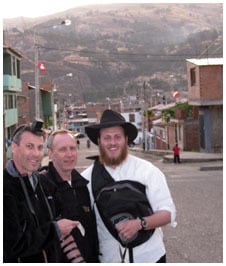
"Sure."
"No, we can't do that."
So we went to his hotel on the other side of town (only 15 minutes of walking) and did our thing.
On our way back, we heard a man tell his friend "Hey, look, two Hasidim!"
After days of Hebrew and Spanish, it sure was refreshing to hear some American English!
Bill (an art director) and Gary (a writer) are both New York Jews. Surprisingly, neither of them had put on Tefillin since their Bar-Mitzvahs.
To report next time from Ica, Peru,
Rafi and Mendel
|
AZ Jewish News
August 04 2023
Grand Forks Herald
July 24 2023
The West Australian
July 23 2023
Los Alamos Reporter
July 17 2023
Wahpeton Daily News
July 17 2023
|
- Snippets of Inspiration From our Passover 2018 Roving Rabbis
Friday, May 04, 2018 - Bill Brought Us the Greatest Gift
Friday, May 04, 2018 - Then and Now: My Jewish High School Friend Revisited
Wednesday, April 25, 2018 - A "Chance" Encounter in the Canary Islands
Wednesday, April 25, 2018 - A Spirited Seder in Szczecin
Thursday, April 12, 2018 - A German Jew in the Spanish Islands
Thursday, April 12, 2018 - A Bar Mitzvah at 102
Monday, October 16, 2017 - An Impromptu Bar Mitzvah in a Camera Shop
Wednesday, September 13, 2017 - Stop the Car or Turn Left?
Tuesday, September 12, 2017 - Finding Jews at the Sziget Music Festival
Tuesday, September 12, 2017 - Subscribe
