


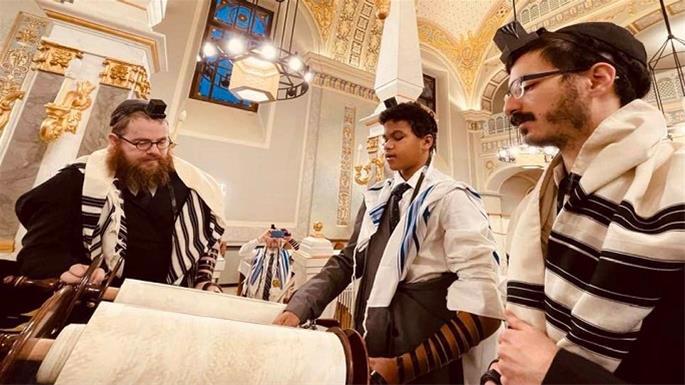
When the Torah is publicly read in the synagogue (on Shabbat, Monday and Thursday mornings, holidays and fast days), congregants are called up for an aliyah. Originally, the person called up (the oleh) would read a section of the reading himself. But because many lack the training necessary to chant the reading, there is a designated "reader" who reads the section out loud, while the oleh reads along quietly (or listens).
Aliyah means "ascent," referring not just to the climb to the reading table platform but also to a spiritual elevation. Our sages explain that G‑d constantly speaks the words of the Torah; when the oleh goes up to the Torah, G‑d speaks through him.
When:
How:
The gabbai (beadle) announces (in Hebrew): "Arise, so-and-so son of so-and-so!" If there is a Kohen present, he is honored with the first aliyah, and a Levite receives the second aliyah. In many synagogues the oleh dons a tallit.
Stand to the right of the reader, who will point to the beginning and end of the reading. Touch these with the corner of your tallit (or the Torah's sash) and kiss it. Close the Torah, hold both handles and recite the first blessing.
Hold the Torah's handle while the reader reads your section. If possible, follow the Hebrew words inside the Torah scroll and read along silently.
When the reading concludes, kiss the end and the beginning with your tallit, close the Torah and say the second blessing.
Click here for the text of the blessings.
After your aliyah, stand to the right of the reading table until after the following aliyah.
Note: Not experienced? Don't worry. The gabbai will guide you through the process!


A Protected Space I love being separate from the men in the synagogue. The mechitza or separation gives Jewish women a protected space in which to pray, without a bunch of men staring at us. It's a special, private place in which we can cry over our prayer books, beseeching G-d Alm-ghty to send us and our loved ones blessings for health and happiness. Why would anyone want to do away with this specialness, this holiness? It's not a theater or a market, it's a place of communion with G-d. It takes the energy and effort of ten men to equal the prayers of one sincere Jewish woman, and ten pairs of tefillin can't even begin to measure up to one woman's tears. If we're better than ten of them, why demote us from our lofty pinnacle? How many evil decrees against the Jewish people get torn up every day due to the heartfelt entreaties of devoted mothers and grandmothers? Why would any concerned, thoughtful woman want to do away with this special separation that makes us holy?