


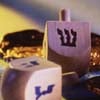
Do you know the rules of Dreidel? You spin a top with four Hebrew letters on it. A Gimmel wins the whole kitty, a Hei gets you half, Nun gets nothing and for a Shin you must pay in. Aside from the inherent Kabbalistic meaning behind this method, there is the practical Yiddishe origin. Gimmel stands for Gantz, meaning the whole thing. Hei is for Halb, meaning half. Nun stands for Nisht or nothing. And Shin is for Shtell arein or put in.
These are four basic modes of being, depending upon the person, his or her period in life, or the particular day. We all have our Gimmel days. This is when we feel that everything is going great and turning out in a sensational way. (It's been a while, eh?) We have our Hei days, when things are going quite well. The Nun and Shin need no explanation.
But each of these letters represents only one face of the Dreidel — only a single angle or perspective of the whole. What do the letters spell out? What is the "whole" of the Dreidel? Ness Gadol Hayah Sham, "a great miracle happened there." This refers to the great miracle of Chanukah that occurred in the Holy Land. The situation there seemed dire and beyond hope. They were definitely having a Shin day. The commitment of a few people turned the situation around (like a Dreidel) and brought out the miracle and G‑d's salvation.
The Macabees did not dwell on the fact that they were being oppressed and persecuted. They focused on the Gimmel that was on the other side of the Shin. And then they acted to create a vehicle for a Divine miracle.
It is vital to remember that whatever letter we seem to be getting at a particular point in life, it's all part of one Dreidel. And that Dreidel is telling us that miracles happen. We can transform the dark situations of life into the bright light of the Chanukah Menorah. This depends upon our faith in G‑d’s plan, and our commitment to create a vehicle for the miracle.
The Dreidel in the Bible?
Based on this theme we find a phenomenal "coincidence" with these four letters of the Dreidel. The first place where these letters occur as a word in the Torah is in the Parshah (Torah Reading) of Vayigash (Genesis 44-47, always in proximity to Chanukah), where they spell the word Goshnah, meaning "to Goshen."
The Patriarch Jacob was sending his son, Judah, to the Egyptian city of Goshen to set up a house of study, in advance of Jacob's, and his entire family's, relocation to that land. Our patriarch was aware that this was a dreadful descent into exile. But he looked at all of the letters of the Dreidel, and realized that hidden in the exile are the seeds of redemption. Study must continue, especially in exile. As long as we are able to retain the vital Divine information, the exile cannot hold sway over us. And our study and performance become the vehicle for the ultimate redemption.
This is similar to the origin of the Dreidel. According to tradition, during the times of Greek oppression Torah study was forbidden. When the children were studying, they would keep a Dreidel nearby to pull out and play in case they were discovered. (A bit opposite from our Hebrew school experience, perhaps.) At the time, the students may have thought that the game was a distraction from their true purpose in life. But in truth, G‑d conceals His countenance to draw out our commitment and connection to Him. It's all about revealing the Divine in the least likely places. That's what a miracle is.
The Dreidel was the formula to elicit the underlying truth of the Jewish soul.
The Dreidel and Moshiach
And one more idea. If you add up the Gimatria (the Hebrew numerical value) of the letters of the Dreidel, you get 358 (Nun (50) + Gimmel (3) + Hei (5) + Shin (300) = 358). This is the same value as Moshiach (Mem (40) + Shin (300) + Yud (10) + Chet (8) = 358), the Messiah. When the Moshiach comes, he will teach each individual how to see the Divine purpose in every facet of life. Even the time of exile and darkness will be illuminated.
We may have been focusing on one particular letter. Moshiach will teach us to see that all of life is a tapestry of Divine wonder.



Very great historical context to share with my friends and family.