


Conventional wisdom of business administration dictates states that a successful entity requires two equally vital forces: a visionary and a builder. The visionary ensures the entity remains aligned toward its long term objectives. The builder implements that vision, directing the mechanics of the operation towards its intended goals.
Usually, the vision person, standing at a 20,000 story level or higher, has a birds-eye view and is not capable and unable to see and run things on the ground level, which requires immersion into the nitty-gritty details. And vice versa: The implementer needs to see things as they are below and cannot remain on a pedestal.
Vision alone can remain abstract and unfulfilled without someone who knows how to implement and build accordingly. Building without vision is aimless.
You may be surprised to hear that the first model for balancing these two forces goes back 3320 years ago. The model for all structures – for all entities – both physical and spiritual, microcosm and macrocosm, is the holy Temple.
"Build me a sanctuary and I will rest among you." The purpose of existence is to build a Divine home from and within our material universe. Building this home is thus a model for every form of building that we will ever devise – from our grandiose structures in our sprawling cities to our businesses and corporations, from our personal lives, homes and families to our social structures.
As such, the construction of the Sanctuary offers us many continual lessons in life. This explains why the Torah – in these weekly chapters – elaborates about every detail of the Temple’s construct, not once, but three times.
When we look closely at the Torah narrative we find a discrepancy in the order of the Temple’s assembly: When G‑d first commands Moses (in parashot Teruma and Tetzaveh) the order is first to build the vessels (the ark, the table, the menorah), and then the structure itself (the walls of tapestry and the beams). But later, in these week’s parasha, when Moses instructs the people to build, the order is reversed: first the Mishkan – the structure – and only afterwards the vessels.
The Talmud relates a mysterious but fascinating dialogue between Moses and Bezalel, the Temple’s builder, about this order (Berochot 55a. Cited in Rashi at the opening of Pekudei):
When Moses told Bezalel to first construct the vessels and then the structure, Bezalel responded, "Moses, our Rabbi, the way of the world is that first one builds a home and afterwards he puts in the furnishings. But you tell me to build the ark and vessels and then the Tabernacle. Where shall I put the vessels I make until the Tabernacle is finished? Perhaps G‑d really said it to you in a different order, Tabernacle, ark, vessels?" Moses responded: "perhaps you were under G‑d's shadow (the literal meaning of the name "be-zal-el") and knew what G‑d intended." Moses then deferred to Bezalel.
Why then did Moses reverse the order and maintain that first the vessels should be constructed than the structure? Indeed, if Bezalel was right that the order should be first to build the structure and then the vessels, why did G‑d in the first place command Moses precisely in the opposite order? Why confuse matters?
The answer is that both Moses and Bezalel were right. One spoke from the perspective of the visionary, the other from the viewpoint of the builder:
A visionary – the driving force that should stand behind every initiative – sees the end in mind; he always maintains focus in the mission and purpose of the entire operation. The ultimate purpose of the Temple lies in the vessels – the Divine service performed with the vessels. The structure is necessary to protect and surround the vessels within. Moses, man of G‑d, was the visionary who saw right at the outset the end purpose – which is to create containers for the Divine.
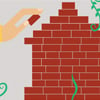
The builder who implements the vision, on the other hand, must define the actual method and order of assembly. Bezalel, the builder and implementer, recognized the practical process, "the way of the world: first one builds a home, and afterwards one puts in the furnishings."
Moses’ and Bezalel’s symbiotic relationship in constructing the Divine Temple carries vital lessons in our lives:
Ask yourself the question: Who controls your life: The details and daily mechanics or a higher vision and purpose? Who is the captain of your ship: is your body following your soul, or is your soul following your body? Does the hammer tell your hand what to do or the other way around?
It may seem strange, but due to life’s circumstances and the struggle for survival, most of our lives are consumed with the means – working, commuting, shopping, preparing, with little time and energy available for the end – the reason we invest all that effort: love, family, virtue, personal growth, making a mark on the universe. This of course, creates the inevitable, undesired and contradictory result: We can forget the destination as we get overwhelmed with the journey. Instead of your mission defining your activities and circumstances, the order is reversed.
On the other hand, sometimes we can get carried away with vision and illusions of grandeur, which – even if they aren’t illusions – often don’t come to realization due to their grandiosity. You may be afraid, or not know where, to begin, concerned that not every detail was covered or that there may be another way to go.
First and foremost we need the voice of Moses within: the vision. Then we need to balance that with the voice of Bezalel: the builder.
In our lives, each of us should have has both these personalities, forces and characters: First the visionary – that distinguishes between the means and the ends, and makes sure to emphasize and keep focused on the purpose of all the work we do in life. Never forget the purpose. Then there is the builder who understands the right order how to actualize the process.
Obviously, some of us excel at one more than the other. Nevertheless, we all carry both voices. And even more importantly, we are expected to be wise enough to consult and bring on board an objective expert that can help complement our own weaknesses.
Which is more important? Both: vision and execution. The idealism of a visionary can remain abstract and unrealized. The greatest vision will fail if it does not have a designer and builder that will execute and realize the vision. A builder on his own, without vision, can get distracted and carried away with the means, and forget the end. We need both: the end in mind and the order of priority.
This is the secret to success: Moses and Bezalel – a partnership that left us with a holy Temple, which served as a model for the Temples to be built later in Jerusalem, and the permanent Temple of the future and above all – provided us with a permanent model to create a home for our souls and for the Divine ("I will rest among you").
How many partnerships can claim such success?
[Reprinted from meaningfullife.com, copyright: The Meaningful Life Center, 2008.]


Start a Discussion