|
|
Today is Wednesday, November 25, 2026 – 15 Kislev, 5787
|
Good morning and happy Wednesday!
Many Americans are heading into a Thanksgiving break. We'll keep shipping the Timeline all week (Torah study is an every-day imperative, and perhaps all the sweeter after turkey and pumpkin pie), but there is an important lesson to be learned about gratitude.
Today's Chumash helps us understand the true meaning of Jewish thanks.
|
|
|
|
|
|
|
Happy Jewish Thanksgiving!
|
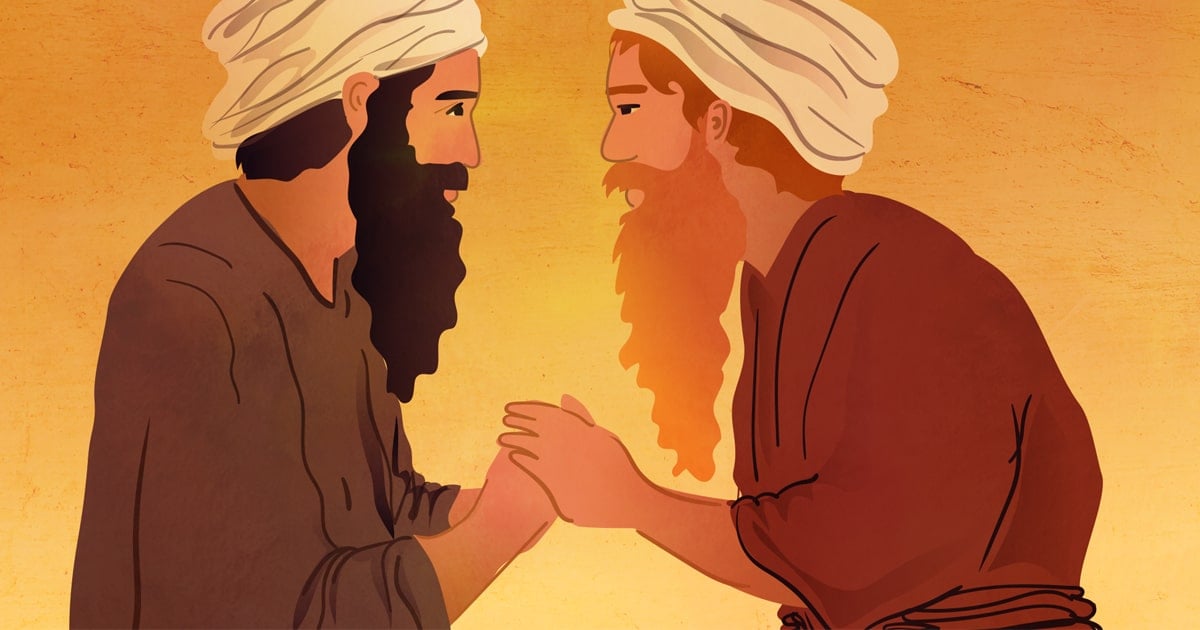
"But Esau said, 'I have plenty, my brother; let what you have remain yours. Jacob said, '...for G-d has favored me, and [because] I have everything.'’"
— Vayishlach 33:9-11
What separates Jacob from Esau? When the two brothers meet in today's Chumash, both have grown considerably since they last saw each other. Jacob spent twenty years working for his father-in-law Laban, consumed by scorching heat by day and frost by night (as he described last week, Genesis 31:40). Yet now he is wealthy, with livestock and servants and, more importantly, his family, the twelve tribes of Israel.
Esau too had prospered. He had become a warlord, with a large family of his own and an army of 400 men. Yet when Jacob presses a gift on him, Esau does not thank G-d. Instead he notes that he has "plenty."
The difference is in the words. The word for plenty, rav (רב), suggests a multitude of separate things, each one counted. Esau, ever the lustful one, never saw enough in the items he had.
Jacob, however, said he had "everything." Jacob was content with whatever he was given. The Hebrew word for everything, kol (כל) means not just a collection of disparate items but a holistic entity, an indivisible unity.
The same contrast shaped the households the two brothers built. As the Midrash observes, the Torah calls Esau's family "souls" (nafshot) in the plural (Genesis 36:6), a collection of fragments. The family of Jacob that went down to Egypt is called "soul" (nefesh) in the singular (Genesis 46:27), though they numbered seventy, because they were one.
Ever the thankful one, Jacob found unity and connection where Esau saw division and desire. At the Thanksgiving table, it's easy to give thanks for the parts: the food, the family, the day off. Jacob's thanks is for the whole, and for the One who gave it. Plenty counts what we have. Everything is grateful for it.
Today's Timeline is based on Torat Menachem 5717, Bati LeGani. Explore it in Hebrew on the Torah Texts platform.
|
|
|
|
|
|
|
The Rebbe on America’s Founding Faith and Divine Destiny
|
The Rebbe stressed the unique American messaging of Thanksgiving. A day set aside to give thanks to G-d for the kindness He has done for us. How ought we to view the Jewish experience in the United States? When the Sixth Rebbe, Rabbi Yosef Yitzchak Schneersohn, reached New York's shores from war-torn Europe in the spring of 1940, he proclaimed that "America iz nit andersh"—that Jewish life could thrive here just as before. His successor, the Rebbe, frequently revisited this foundational message.
Simultaneously, the Rebbe consistently described this land of freedom as harboring a distinct God-given mission. Does this present a contradiction? Does America mirror the lands of old, or does it hold a special place?
My colleague Dovid Margolin explores this question in, "The Rebbe on America’s Founding Faith and Divine Destiny." He examines a seminal 1975 address where the Rebbe analyzed the motivations of the early settlers, the vision of the country's founders, and the core values of the nation.
Thus, while holy tradition remains unchanged in the New World, by harnessing the country's freedom to elevate the world around us, we demonstrate that America is truly unique.
|
|
|
|
|
|
|
We, the American citizenry, are a thankful lot. Our calendar is dotted with days when we express our gratitude to various individuals and entities. And then there is Thanksgiving. The day when we thank G‑d for enabling all the above—and for all else He does for us.
|
On Saturday night, 1,500 Jewish teenagers gathered on the Champ de Mars in Paris to mark the end of Shabbat with an open-air Havdalah ceremony. Waving the flags of the countries they call home, they recited the Shema together, praying for peace and for the safety of Jewish communities around the world. The rally capped the European Jewish Teen Congress, a weekend that brought more than 800 teens from 30 countries to Paris.
|
In an industry where immediate availability and around-the-clock hustle can make or break a career, Daniel Poneman, founder of Weave, a sports agency representing more than 300 college and professional basketball players worldwide, has some nonnegotiables. He keeps kosher. He observes Shabbat and Jewish holidays.
|
My trip to Bhutan was part of my seven-year sojourn in China. I didn’t intend to stay for so long, and I certainly never imagined it would lead me back to Judaism.
|
|
|
|
|
|
|
How to Make Cranberry-Stuffed Challah
|
Carry Thanksgiving into Shabbat by swirling your leftover cranberry sauce into homemade challah. And make this challah even better with a streusel crumb topping! Let us know how your Cranberry-Stuffed Challah turned out!
|
|
|
|
|
|
|
Rabbi Judah the Prince (188 CE) — Rabbi Judah the Prince, also known as Rabbeinu Hakadosh ("our holy master") or simply "Rabbi," was elected nasi, the spiritual and civil head of the Jewish people, after the death of his father, Rabbi Simeon ben Gamliel. Foreseeing that the tribulations of exile would cause many laws to be forgotten, he gathered, edited, and organized the statements of the earlier sages, setting the Oral Law down in writing for the first time in the form of the Mishnah. He passed away around 188 CE; some say 219 CE. Although he was extremely wealthy, in his dying hour he lifted both hands to Heaven and swore he had not benefited from his wealth even with his little finger. The Talmud (Ketubot 103a) relates that for a time after his passing he would still visit his home every Friday at dusk and recite Kiddush for his family. Links: Rabbi Judah the Prince; The Compilation of the Mishnah
|
|
|
|
|
|
|
Questions or comments? Reply to this email—We love to hear from you!
|
|
|
|
|
Timeline is a daily email from Chabad.org,
crafted by Rabbi Mordechai Lightstone.
Get deeper, refreshing insight illuminating the daily study of Chitas, the timeline of our lives: Chumash, the weekly Torah portion in the Five Books of Moses, the daily Tehillim, Psalms, and the foundational Chassidic text of Tanya, authored by Rabbi Shneur Zalman of Liadi, the founder of Chabad, chapters from the Rambam, Maimonides’ Mishneh Torah and Hayom Yom, a daily collection of Chassidic aphorisms compiled by the Rebbe.
|
Written with love in Brooklyn, NY. All em dashes in this email are human-generated.
|
|
|
|
|